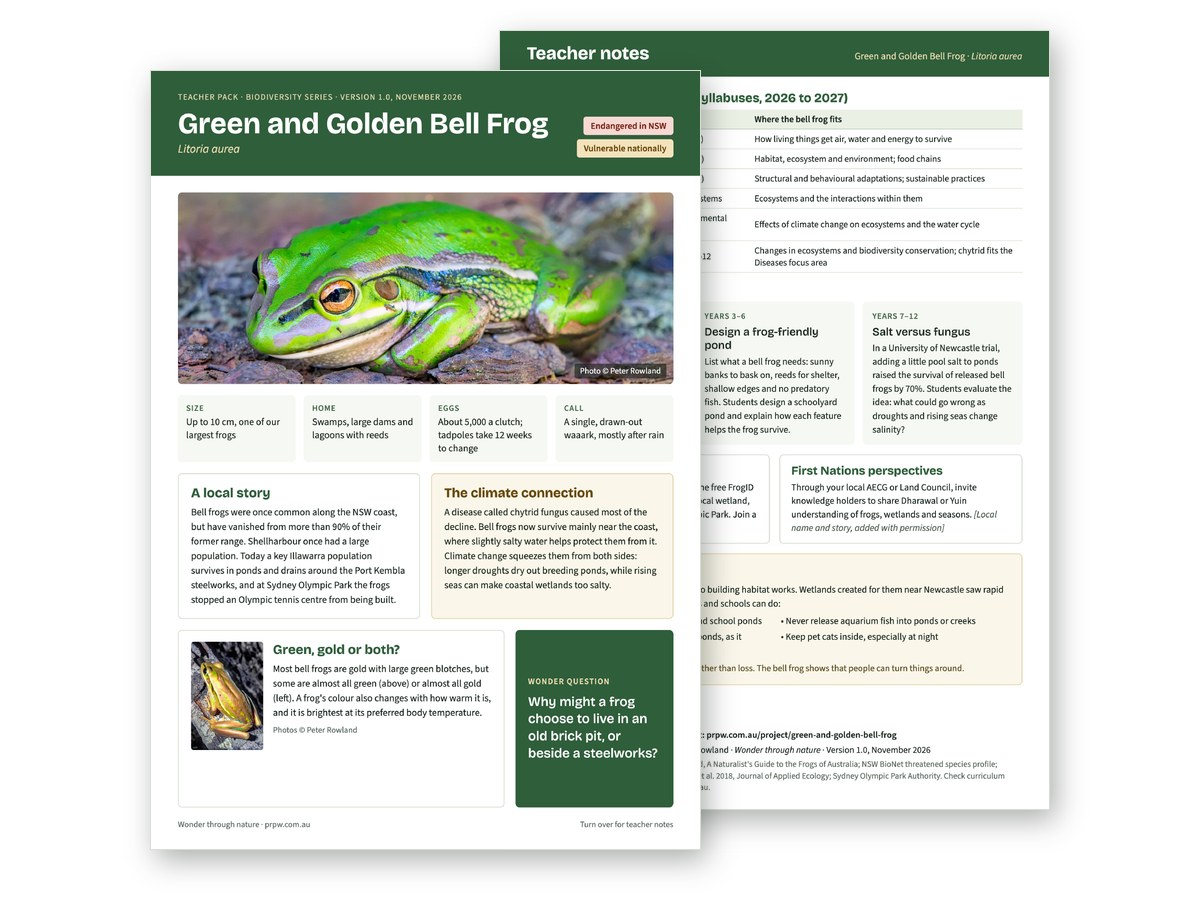
Green and Golden Bell Frog
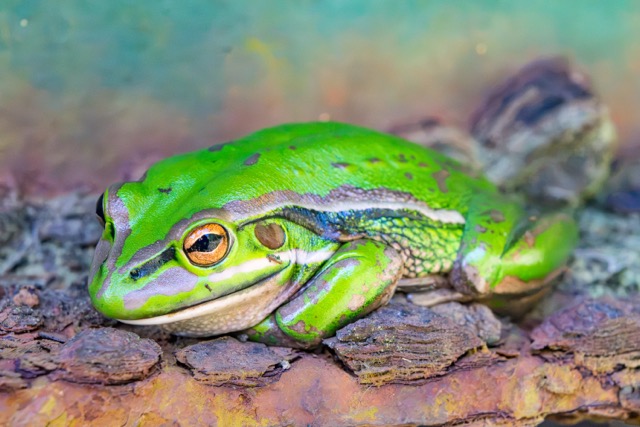
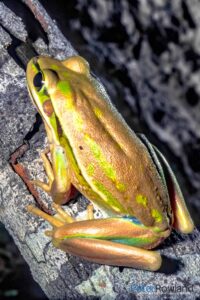
Green, gold or both? Most bell frogs are gold with large green blotches, but some are almost all green (above) or almost all gold (below). A frog’s colour also changes with how warm it is, and it is brightest at its preferred body temperature.
This species features in my book A Naturalist’s Guide to the Frogs of Australia


Scientific Name: Litoria aurea
Other names: Golden Bell Frog; Green and Gold Swamp Frog
Size: up to 10 cm
Status: Endangered in NSW; Vulnerable nationally
What does it look and sound like?
Appearance and key features
The Green and Golden Bell Frog is one of Australia’s largest frogs, growing to about 10 cm. Its colouring varies, but most frogs are gold with large green blotches and spots, and some are almost all gold or all green. A pale stripe runs along each side of the body, the insides of the thighs are bluish, and the belly is white. The back is smooth, without warty bumps.
Colour also changes with temperature. A frog is brightest when it is at its preferred body temperature, and can turn dark and dull when cold or inactive. Unlike many frogs, bell frogs are often active by day and like to bask in the sun.
Call
Males call from floating plants and among reeds near the water, from spring to autumn and mostly after rain. The call has been described as a single, drawn-out waaark.
Similar species
The Growling Grass Frog (Litoria raniformis) looks very similar, but has raised bumps on its back. The Yellow-spotted Bell Frog (Litoria castanea) has bright yellow patches on the backs of its thighs, which the Green and Golden Bell Frog lacks.
Where is it found?
Distribution
The Green and Golden Bell Frog is found in south-eastern Australia, from Orbost in Victoria to near Byron Bay in northern NSW. It was once one of the most common frogs on the NSW coast and tablelands, but has disappeared from more than 90% of its former range. It has vanished from cooler upland areas, and most of the roughly 50 populations recorded in NSW since 1990 are small, coastal and isolated from each other.
Conservation status
The Green and Golden Bell Frog is listed as Endangered in NSW and Vulnerable nationally. Its decline is due mainly to chytrid fungus, a disease that has killed frogs around the world, together with habitat loss, introduced fish that eat its eggs and tadpoles, and predators such as foxes and cats.
What are its habitats & habits?
Habitat
Bell frogs favour swamps, large dams and lagoons with reeds and sunny banks, and also use southern wallum swamps. Many surviving populations live in surprising places: old quarries, brick pits, golf courses and industrial land. They quickly move into new ponds, which is part of why these disturbed sites suit them.
Habits and breeding
Bell frogs eat insects and other invertebrates, and will also eat other frogs, including young bell frogs. Breeding happens in the warmer months, mostly after rain. Spawn may float in clusters or be wrapped around water plants below the surface, and a clutch averages about 5,000 eggs. Tadpoles can grow to 8 cm long and take about 12 weeks to become frogs.
Why it's in trouble, and why there's hope
A local story
The Illawarra once had a large population of bell frogs at Shellharbour. Today a key Illawarra population survives in ponds and drains around the Port Kembla steelworks, where habitat is managed for them. In Sydney, the discovery of about 300 bell frogs in an old brick pit in 1992 stopped a tennis centre for the 2000 Olympics being built there. The site is now protected frog habitat, with an elevated walkway above it.
The climate connection
Bell frogs now survive mainly near the coast, where slightly salty water helps protect them from chytrid fungus. Climate change squeezes them from both sides: longer droughts dry out breeding ponds, while rising seas can make coastal wetlands too salty.
Reasons for hope
In a University of Newcastle trial, adding a little ordinary pool salt to ponds raised the survival of released bell frogs by 70%. Because bell frogs move into new ponds quickly, building habitat works: wetlands created for them near Newcastle saw rapid population growth. A chytrid-free population on Broughton Island, off the NSW central coast, is a precious insurance population.
For teachers
A free two-sided A4 sheet for NSW classrooms, with curriculum links from Early Stage 1 to Stage 6, activities for K–2, Years 3–6 and Years 7–12, and ideas for getting outside. It is part of the PRPW Wonder through nature biodiversity series.