Bogong Moth
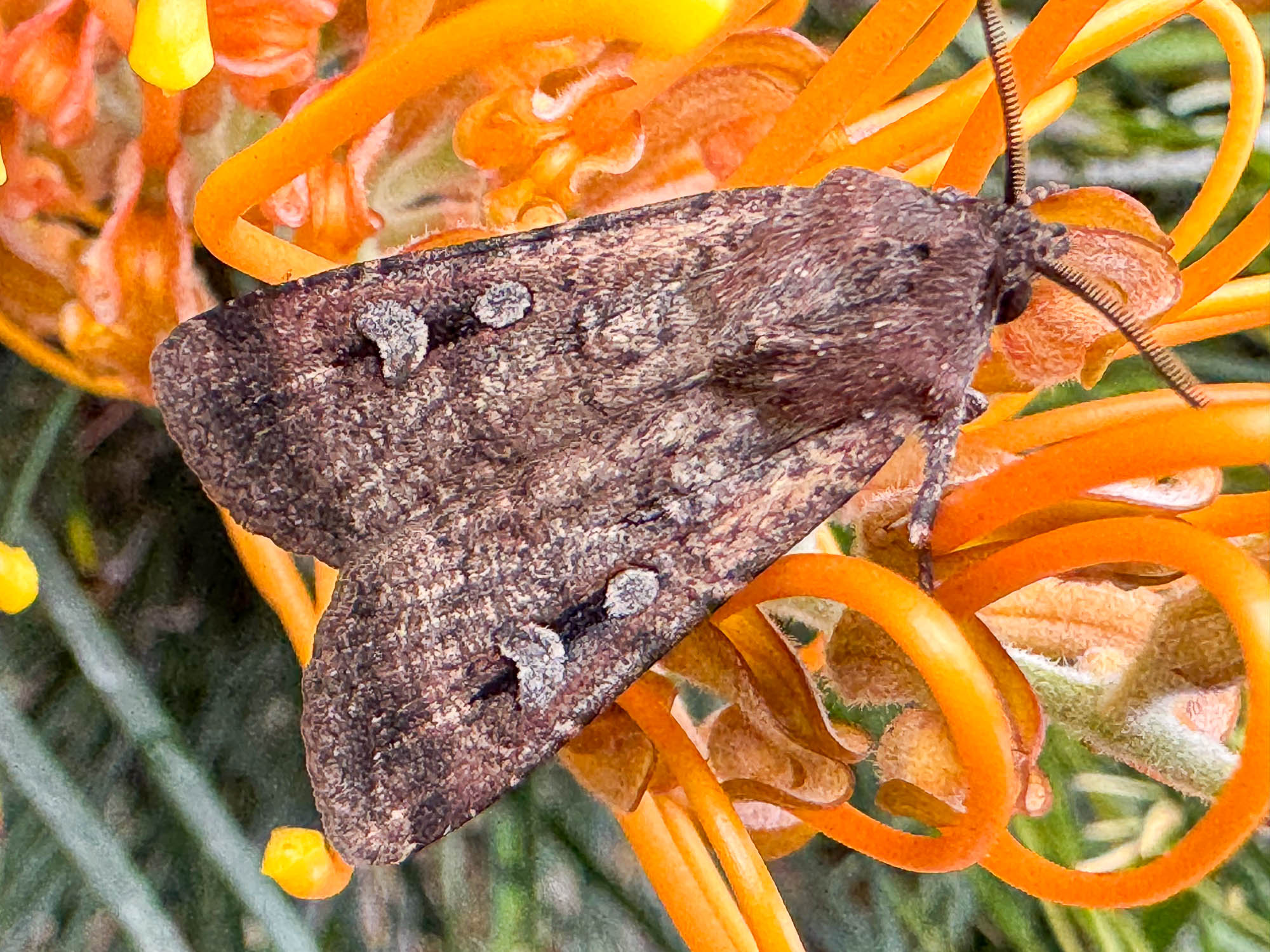
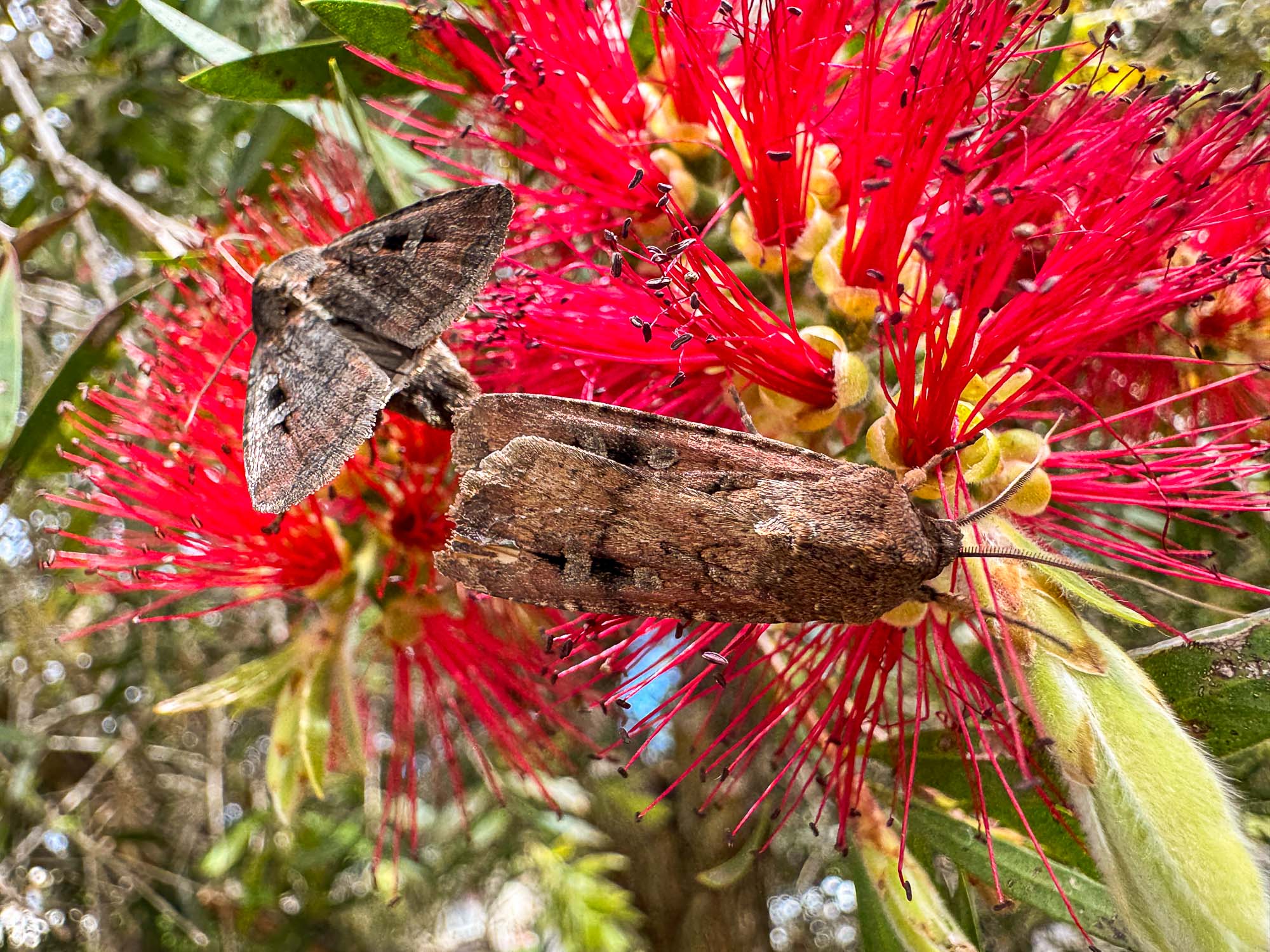
During the 2026 Bogong Moth “invasion” on the NSW coast, I stopped for lunch in Gerringong and was amazed at the numbers feeding on a grevillea bush in the middle of the day. My video is above.
For teachers
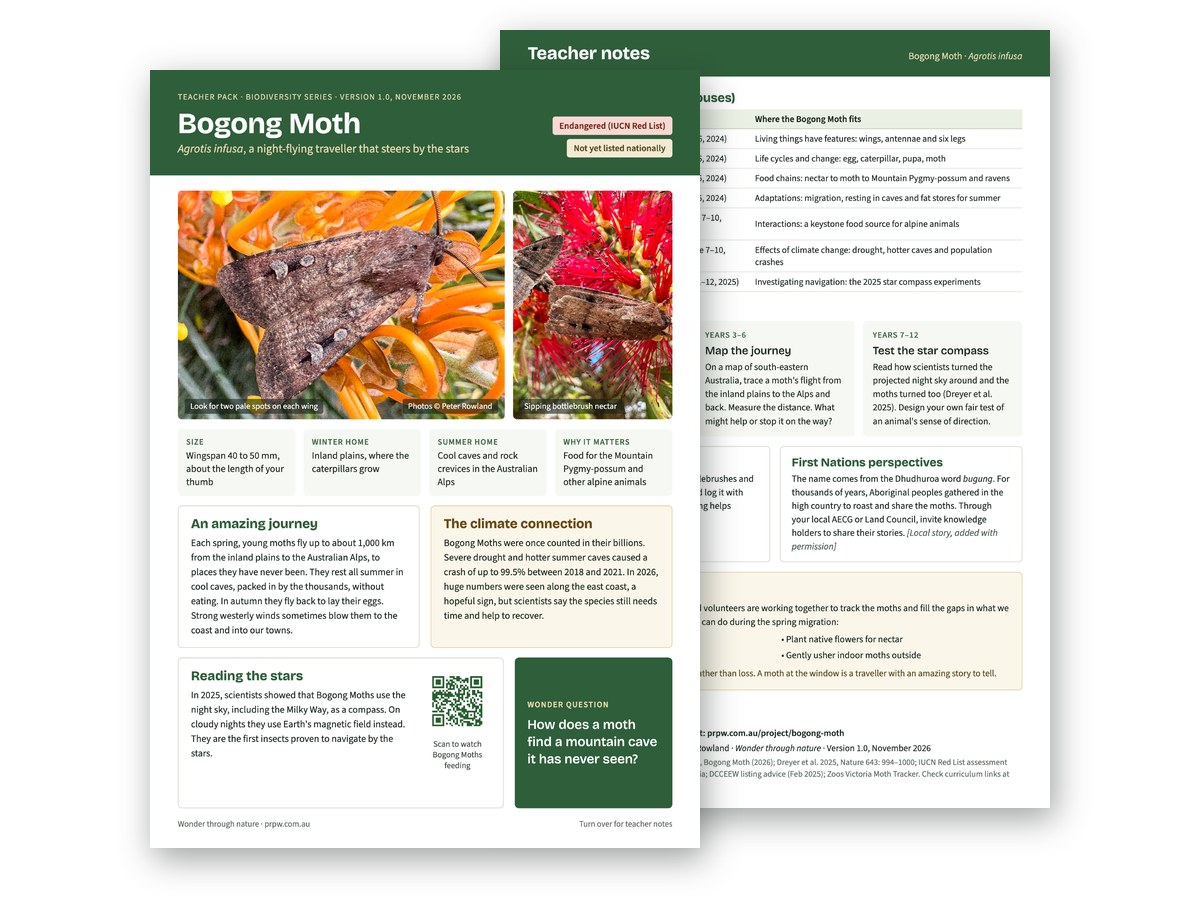
A free two-page Bogong Moth teacher sheet, with a student page, curriculum links and classroom activities.
Scientific Name: Agrotis infusa
Size: Wingspan 40–50 mm; body length 25–35 mm
What does it look like?
A medium-sized, stout-bodied moth. Adults are overall dark brown, with a dark stripe interrupted by two light spots on the wings; you can see them clearly in the photos above. Migratory moths have brown hind wings; nonmigratory moths have paler hind wings. Males have feathery (bipectinate) antennae, while females’ antennae are thread-like (filiform). The caterpillars are known as Black Cutworms. Caterpillars start pale, then turn green with pale and dark stripes and spots. They reach up to 50 mm.
Where is it found?
Bogong Moths breed on the inland plains west of the Great Dividing Range, across inland areas from southern Queensland to South Australia. In summer they gather in the high country of the Australian Alps in New South Wales, the ACT and Victoria. The species is occasionally found in New Zealand and Norfolk Island. Westerly winds sometimes blow them toward the coast. They are attracted to light and may enter houses.
What are its habitats & habits?
In winter, the caterpillars subsist on winter pasture crops and wild crop weeds such as cape weeds within bogong moth breeding grounds, then pupate in the soil. The spring migration starts in early September, moving from lowlands toward the Australian Alps. Over summer they shelter in cool caves and rock crevices, remaining dormant (aestivation) and living off fat reserves. These resting moths are packed tightly together: densities can reach 17,000 moths per square metre. In autumn they fly back to the plains, where females lay up to 2,000 eggs in or near the soil. On their journeys, adults feed on nectar from flowers such as Epacris, Grevillea, and Eucalyptus.
Interesting facts
- Star navigators. Bogong Moths use star patterns, the Milky Way and Earth’s magnetic field to navigate during migration. They are the first-known invertebrates that navigate by starlight. When there were cloudy nights that blocked the stars, the moths oriented themselves in the right direction using Earth’s magnetic field.
- A first-time journey. Each year, every moth makes this huge journey for the first time. This behaviour shows an inbuilt ability to navigate long distances.
- Alpine food. Bogong moths are a keystone species for the health of alpine ecosystems in Australia. They are a crucial food source for critically endangered mountain pygmy-possums and many other high elevation species. Little ravens, currawongs, foxes and bats eat them too.
- First Nations knowledge. “Bogong” comes from the Dhudhuroa word bugung, meaning brown moth. Aboriginal peoples in south-eastern Australia harvested moths from Alpine caves, roasting them and making “moth meat” cakes. Harvests were also intertribal gatherings. At Cloggs Cave in Victoria, moth remains about 2,000 years old are the first confirmed insect food remains found on a stone artefact.
- Conservation status. Bogong Moth numbers suffered a catastrophic 99.5% decline between 2018 and 2021, mainly from severe drought and higher cave temperatures linked to climate change. The IUCN Red List classified the species as Endangered in December 2021, based on a February 2021 assessment. In Australia, it was considered for national listing under the EPBC Act, but in February 2025, it was deemed that there was ‘insufficient scientific evidence’ to support a threatened species listing. The 2026 season brought good news: Zoos Victoria received more Bogong Moth sightings through its Moth Tracker project in one month than in its previous best year, 2024, but researchers caution that the species is still endangered and will take time to recover.
- How you can help. Switch off outdoor lights. Keep cats indoors. If moths get inside, gently usher them out. Avoid insecticides and other toxic chemicals. Plant native flowers to provide food on their migration. You can also photograph and log sightings with Zoos Victoria’s Moth Tracker.


Want to learn more about Australian insects? Grab a copy of my book A Naturalist’s Guide to the Insects of Australia
References
- Australian Museum (2026). Bogong Moth. https://australian.museum/learn/animals/insects/bogong-moth/
- Dreyer, D., Adden, A., Chen, H. et al. (2025). Bogong moths use a stellar compass for long-distance navigation at night. Nature 643: 994–1000. https://doi.org/10.1038/s41586-025-09135-3
- Alpine Resorts Victoria. Bogong moth. https://www.alpineresorts.vic.gov.au/the-resorts/environment/threatened-species-management/bogong-moth
- Department of Climate Change, Energy, the Environment and Water (2025). Listing advice: Agrotis infusa (11 February 2025). https://www.environment.gov.au/biodiversity/threatened/species/pubs/91549-listing-advice-11022025.pdf
- IUCN Red List of Threatened Species (2021). Agrotis infusa, assessed as Endangered.
- SBS News (28 September 2026). ‘A story of hope’: Bogong Moths swarming the east coast are exciting researchers.