
Coastal Saltmarsh
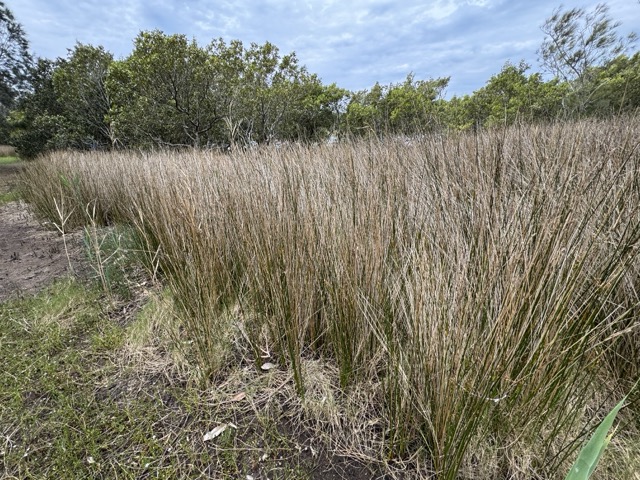
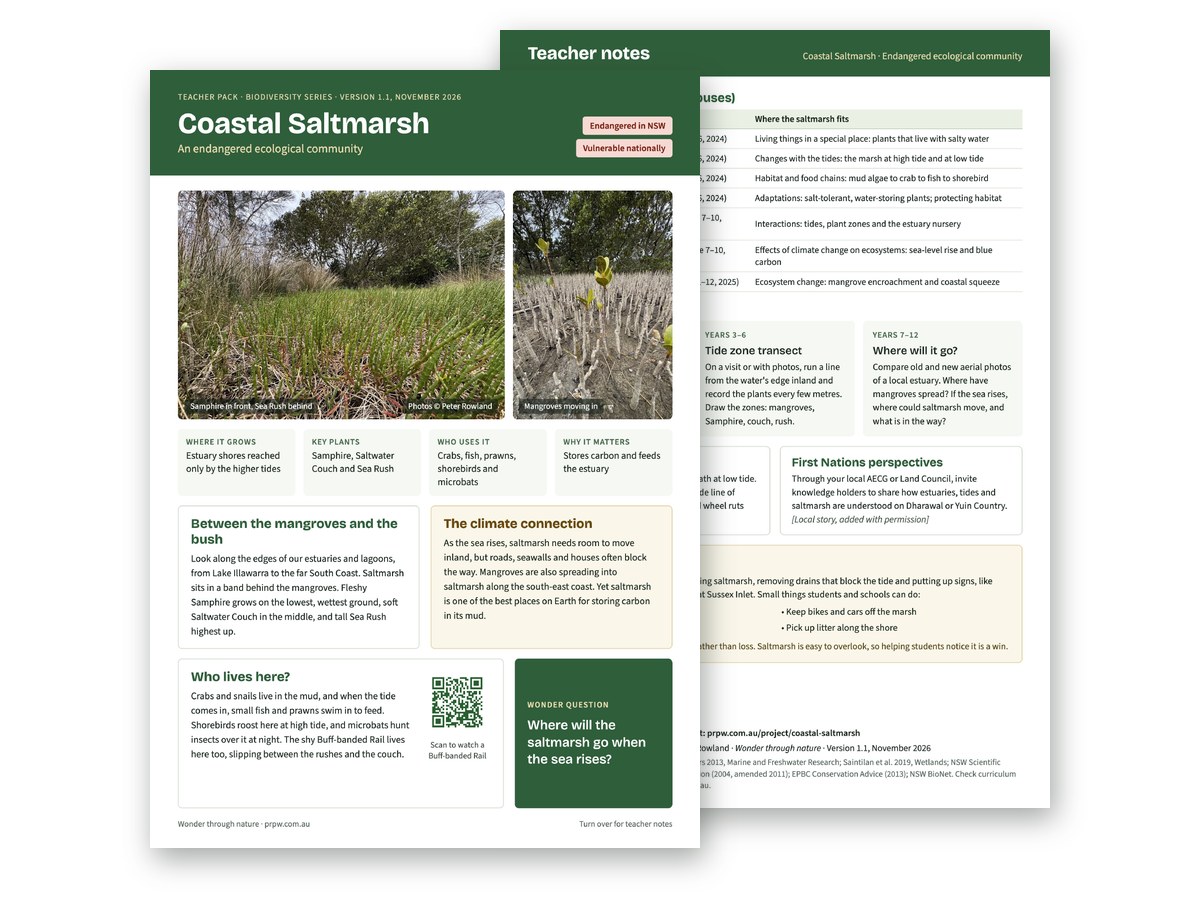
Tall clumps of Sea Rush mark the highest, least often flooded part of the saltmarsh.
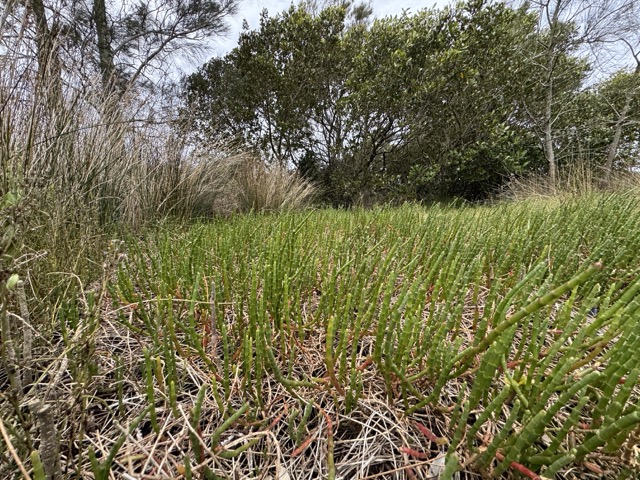
Fleshy, jointed Samphire stores water in its stems to cope with salty mud.
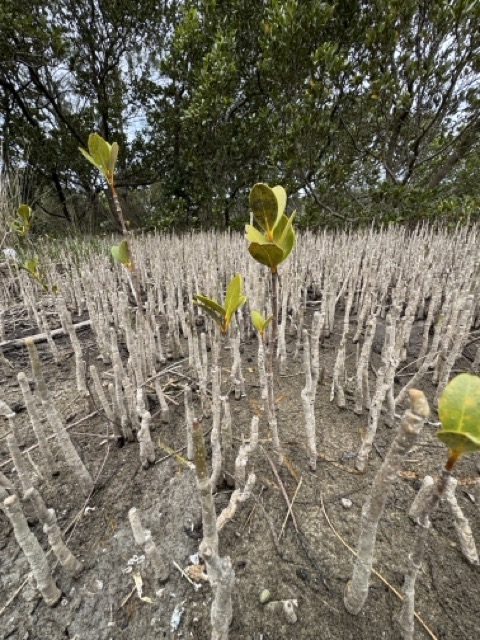
Young mangroves and their breathing roots push up through the saltmarsh at Sussex Inlet, a change linked to rising sea level.
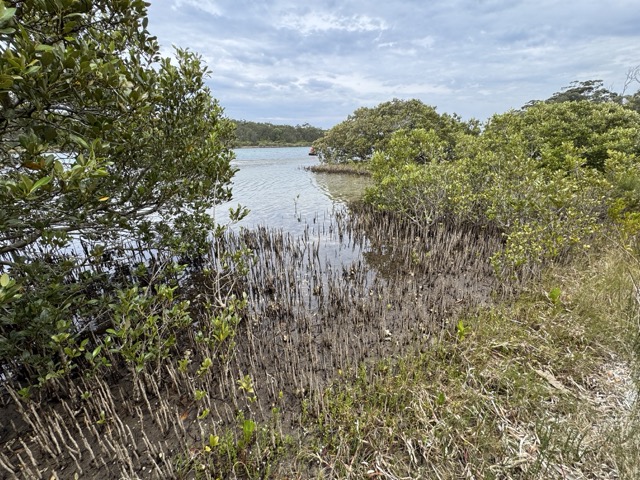
Saltmarsh fringes the estuary between the mangroves and the bush behind.

- Official name (NSW): Coastal Saltmarsh in the New South Wales North Coast, Sydney Basin and South East Corner Bioregions
- Type: Ecological community (a group of plants and animals that live together in one kind of place)
- Status: Endangered Ecological Community in NSW (listed 2004). Nationally, it is part of Subtropical and Temperate Coastal Saltmarsh, listed as Vulnerable (2013).
- Key plants: Sea Rush (Juncus kraussii), Samphire (Sarcocornia quinqueflora), Saltwater Couch (Sporobolus virginicus), Austral Seablite (Suaeda australis), Creeping Brookweed (Samolus repens)
What does it look like?
Coastal Saltmarsh is a low, mostly treeless community of salt-tolerant plants: succulent herbs, grasses, sedges and rushes. From a distance it can look like a scruffy paddock at the water’s edge, but up close it is a mosaic. Fleshy, jointed Samphire turns green to red, Saltwater Couch forms soft carpets, and tall clumps of Sea Rush grow on the higher ground. Bare patches called salt pans are part of the community, and a line of washed-up seaweed and debris often marks the highest tides.
There is no tree layer, although a few scattered Grey Mangroves (Avicennia marina) and mangrove seedlings may grow through it.
Where is it found?
Coastal Saltmarsh grows in the upper intertidal zone on the shores of estuaries and coastal lagoons, including lagoons that are only open to the sea some of the time. It is flooded only by the higher tides, so it usually forms a band between the mangroves on the seaward side and Swamp Oak forest on the landward side.
In NSW it occurs along the whole coast, from the Queensland border to Victoria. It is known from the Illawarra, the Shoalhaven and Jervis Bay, and the Eurobodalla and Bega Valley coasts. Nationally, similar saltmarsh stretches from southern Queensland around the south of the continent to south-western Western Australia, including Tasmania.
Most NSW saltmarsh survives as small, scattered patches. In 1985 the total area in NSW was estimated at about 5,700 hectares, mostly in patches under 100 hectares, and more has been lost since.
What are its habitats & habits?
The plants sort themselves by how often the tide reaches them. Samphire dominates the lowest, most often flooded ground, Saltwater Couch the middle marsh, and Sea Rush and Baumea juncea the highest. Southern NSW saltmarsh is richer in species than saltmarsh further north, with Coastal Speargrass, Saw Sedge and Native Sea Lavender as typical southern plants. Several rare plants grow almost nowhere else, including Australian Saltgrass (Distichlis distichophylla, Endangered) and two wilsonias (Wilsonia backhousei, Vulnerable, and W. rotundifolia, Endangered).
Saltmarsh is busy with animals. Crabs and snails live in and on the mud, and insects and spiders thrive between tides. When the tide comes in, small fish, prawns and shrimp swim in to feed, which makes saltmarsh a nursery for fisheries. Migratory shorebirds use it for feeding and high-tide roosts, and insect-eating microbats hunt over it at night.
Why is it threatened?
Large areas of saltmarsh were filled in for roads, airports, housing, rubbish tips and farms, and smaller-scale filling still happens. Today the main threats are:
- Altered tides, from drains, floodgates and other structures that block tidal flow
- Stormwater, which freshens the marsh, adds nutrients and spreads weeds
- Weeds, especially Spiny Rush (Juncus acutus)
- Vehicles and bikes, whose wheel ruts can last for more than ten years
- Mowing, rubbish dumping, stock trampling and fire
Climate change is a growing threat. As the sea rises, saltmarsh would naturally move inland, but roads, seawalls and houses often block the way. At the same time, mangroves have been spreading into saltmarsh right along the south-east coast over the past few decades, consistent with rising relative sea level. Where mangroves take over, shorebirds lose open feeding and roosting areas.
Interesting facts
- Saltmarshes are among the most efficient ecosystems on Earth at storing carbon. Waterlogged, salty mud locks carbon away for a very long time, and the salt also suppresses the bacteria that make methane, a strong greenhouse gas. Scientists call this “blue carbon”.
- Tiny crabs feed mainly on a saltmarsh grass and on the film of microscopic algae on the mud. They spawn in huge numbers all at once, and their larvae become food for the fish of the estuary.
- Saltmarsh plants live with salt levels that can be higher than seawater. Samphire stores water in its fleshy stems, which is why it looks like a string of tiny green beads.
The secretive Buff-banded Rail is an inhabitant of the coastal saltmarsh, often concealing itself in the tall rushes, and feeding in the adjacent open areas.
For teachers
A free two-sided A4 sheet for NSW classrooms, with curriculum links from Early Stage 1 to Stage 6, activities for K–2, Years 3–6 and Years 7–12, and ideas for getting outside. It is part of the PRPW Wonder through nature biodiversity series.
References
- Saintilan, N. and Rogers, K. (2013). The significance and vulnerability of Australian saltmarshes: implications for management in a changing climate. Marine and Freshwater Research 64(1): 66–79. doi:10.1071/MF12212
- Saintilan, N., Rogers, K., Kelleway, J.J., Ens, E. and Sloane, D.R. (2019). Climate change impacts on the coastal wetlands of Australia. Wetlands 39(6): 1145–1154. doi:10.1007/s13157-018-1016-7
- NSW Scientific Committee (2004, minor amendment 2011). Coastal Saltmarsh in the NSW North Coast, Sydney Basin and South East Corner Bioregions: final determination. NSW Government
- Threatened Species Scientific Committee (2013). Conservation Advice for Subtropical and Temperate Coastal Saltmarsh. Australian Government, Canberra.
- NSW Department of Environment and Climate Change (2008). Identification Guidelines for Endangered Ecological Communities: Coastal Saltmarsh.
- NSW BioNet Threatened Biodiversity Profile: Coastal Saltmarsh. threatenedspecies.bionet.nsw.gov.au