Koala

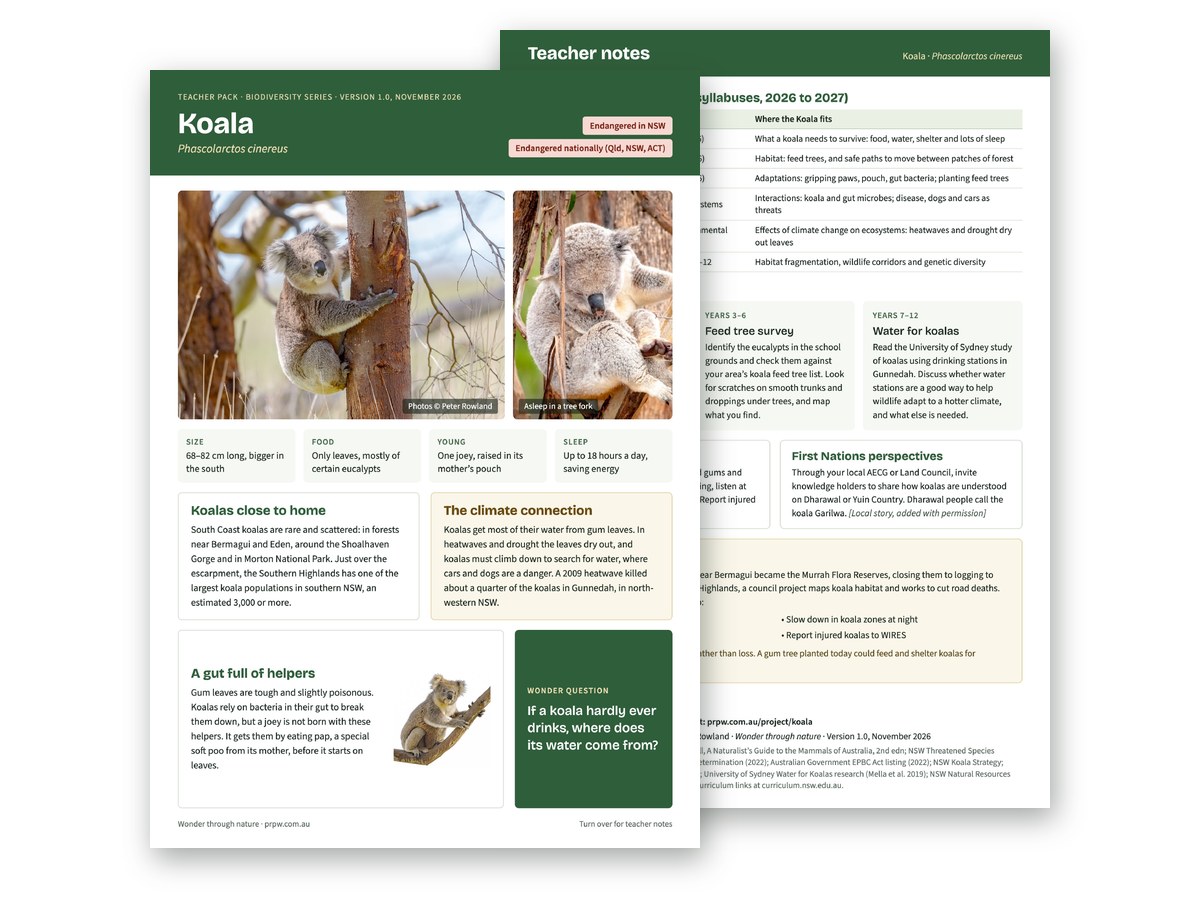
This species features in my book A Naturalist’s Guide to the Mammals of Australia


Scientific Name: Phascolarctos cinereus
Size: 680-820 mm TL (size decreases south to north)
What does it look like?
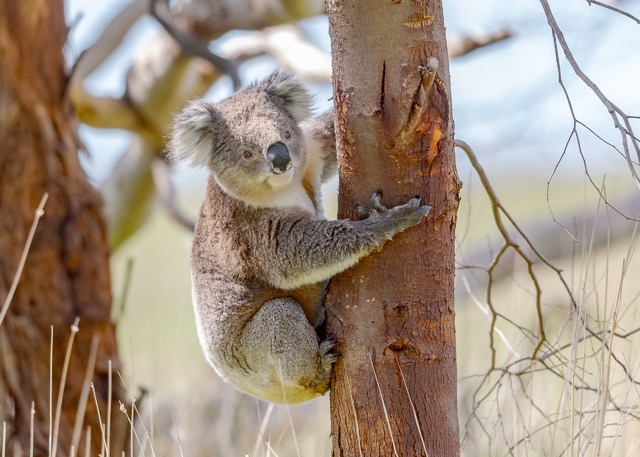
The Koala is a stocky, arboreal marsupial, with thick greyish fur (shorter and paler in north, and longer and more brownish in south). Ears round and woolly, and nose smooth, black and vertically oval-shaped.
Where is it found?
Eastern Australia, from north-eastern Qld (south of Cape York Peninsula), through central and eastern NSW and Vic (and along Murray River), to far south-eastern SA. Introduced to numerous islands, such as Phillip Island Vic and Kangaroo Island SA.
What are its habitats & habits?
Eucalypt forests and woodlands in lowland areas and along river systems. Arboreal, feeding exclusively on leaves, mostly those of certain species of eucalypts, but will walk on all fours along the ground when moving between trees. Female normally produces a single young (joey), which is protected within her pouch.
Interesting facts
The young Koala is not born with the gut bacteria needed to digest eucalypt leaves, and obtains this by eating its mother’s pap (faeces).
For teachers
A free two-sided A4 sheet for NSW classrooms, with curriculum links from Early Stage 1 to Stage 6, activities for K–2, Years 3–6 and Years 7–12, and ideas for getting outside. It is part of the PRPW Wonder through nature biodiversity series.