
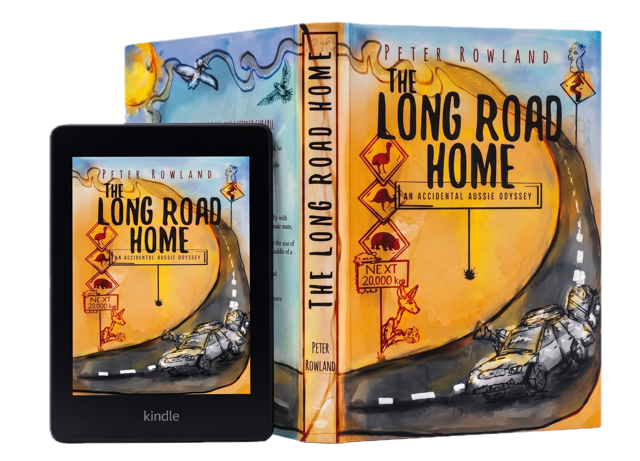
The Long Road Home: An Accidental Aussie Odyssey
The Digital Companion
Welcome to the extended journey.
There is only so much dust and disaster you can fit onto a printed page. This digital companion brings the 1992 odyssey to life, featuring many images of the wildlife I encountered, and the scenery that inspired me (many of the images have been taken since the trip, but some of the original slides are also included). I will also be unearthing and restoring the original video logs, as time, energy, and my own embarrassment permit.
If you are reading the standard edition of the book, you will also find the complete, unabridged appendices waiting for you below.
Nature and Scenes Encountered on the Journey
Part 1: The Great Escape
Our 1992 odyssey began with a frantic, pre-dawn departure from Sydney that was immediately derailed by a leaking trailer and a freezing, 980-kilometre dash to the Victorian coast
-
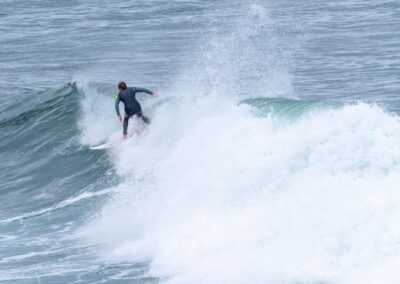
A lone surfer braves the ‘brass monkeys’ cold. His skill was impressive; my desire to join him was non-existent.
-
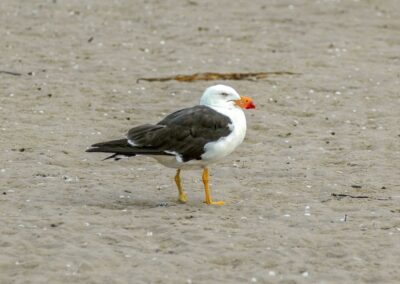
A Pacific Gull, eyeing me with professional disinterest. It was, as I noted at the time, ‘bloody cold for that’.
-
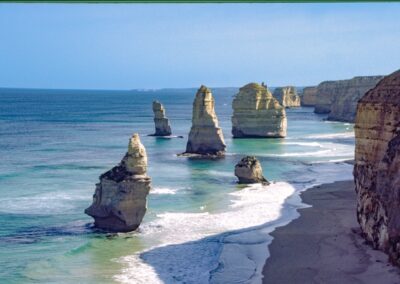
The magnificent Twelve Apostles, standing defiant against the relentless Southern Ocean. Or, as they should perhaps be more accurately named, the ‘Nine Remaining Disciples Who Haven’t Yet Succumbed to the Inevitable.’
Part 2: South Australia (Whales, Watermelons and Wrong Turns)
Our South Australian leg offered a brief reprieve with subterranean cave explorations and vivid blue lakes, though confusing time zones and relentless drizzle soon complicated our progress
-
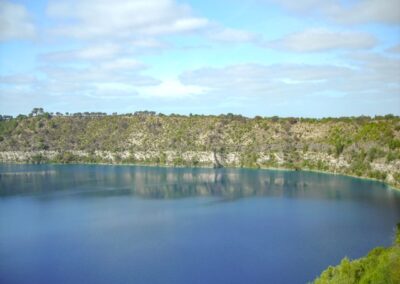
The famous Blue Lake at Mount Gambier. It was decidedly more blue-grey, and ‘wintery’ when I first saw it.
-
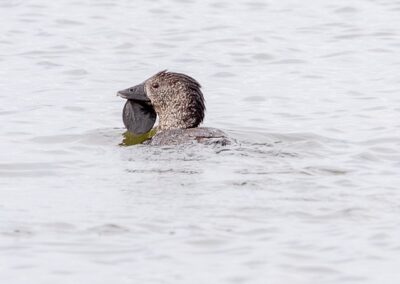
The Musk Duck, a bird that throws conventional elegance out the window, stomps on it with its webbed feet, and then proudly inflates a large, leathery neck-gobble in its general direction.
-
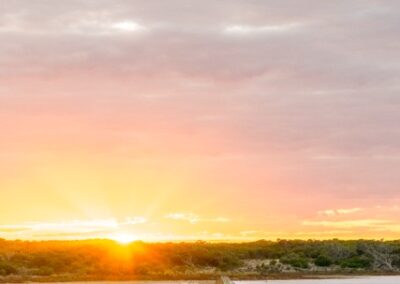
The vast, shallow salt lakes of the Coorong. A landscape of serene lagoons and windswept dunes that, on our visit, was viewed through a curtain of relentless, soul-sapping drizzle.
-
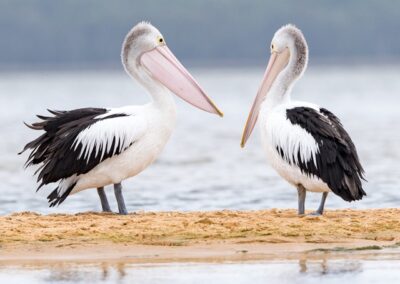
The Australian Pelican, a bird designed on a grand, slightly prehistoric scale. Its enormous, pouched appendage isn’t so much a beak as a built-in, expandable shopping basket.
-
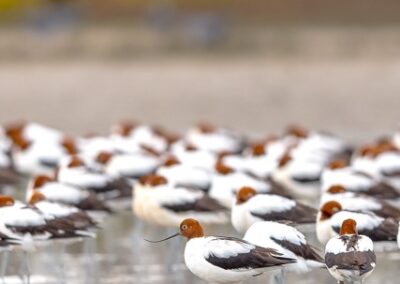
The Red-necked Avocet, its long, impossibly thin bill elegantly upturned at the tip. A moment of delicate beauty in an often damp and dreary landscape.
-
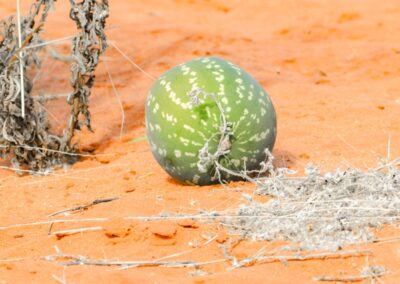
The Paddy Melon, an invasive species whose seeds were spread by early camel trains. Caution is advised; eating one could lead to a rather unpleasant, and historically significant, stomach ache.
-
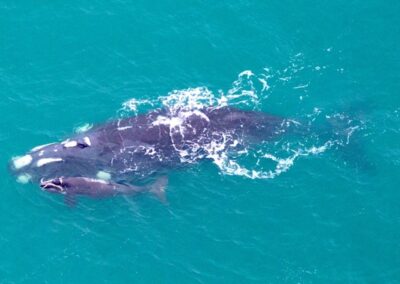
A Southern Right Whale mother and her calf in tranquil southern waters. A moment of pure, unadulterated magic – one you hope you have enough film for [image © Chris Farrell].
-
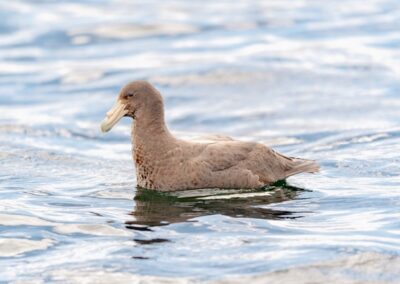
The one-footed Southern Giant Petrel was a highlight at Victor Harbor. For me, an even greater thrill than the whales. A true wanderer of the Southern Ocean, and a stoic inspiration.
-
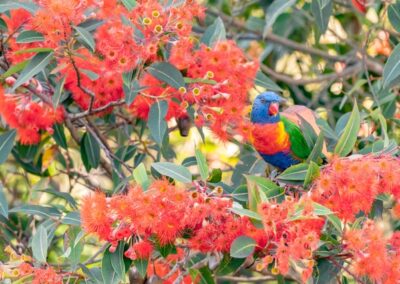
The Rainbow Lorikeet, a bird that looks as though it flew through a paint factory during a particularly violent explosion.
Part 3: The Nullarbor Plain (Halfway Across Australia)
Leaving civilisation behind, we braved the terrifying road trains of the Eyre Highway and camped on a literal ‘bed of nails’ in Kimba before enduring bone-jarring corrugated tracks to view Australian Sea Lions
-
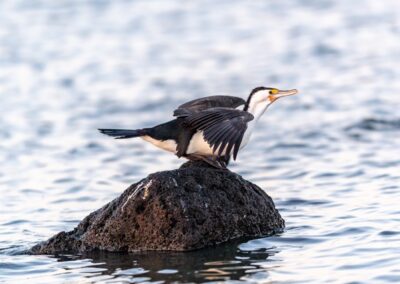
The Australian Pied Cormorant. A classic sight, and often the subject of photographic regret when the long lens is left in the car.
-
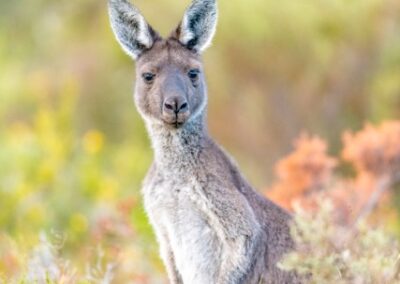
The Western Grey Kangaroo, a creature that seemed to have missed the memo about being a national icon and had instead opted for the persona of a large, long-tailed rabbit deep in thought about a crossword puzzle.
-
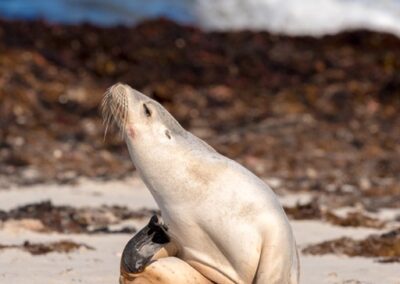
The Australian Sea Lion, a creature of undeniable, almost goofy charisma. Dubbed the ‘puppies of the sea,’ they are fantastically playful and seem to view human visitors with a friendly, inquisitive charm.
-
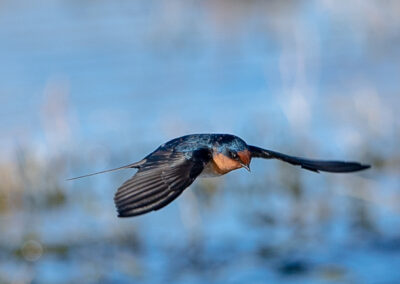
A Welcome Swallow. Their aerial acrobatics signal home... even when you're thousands of kilometres away from it.
-
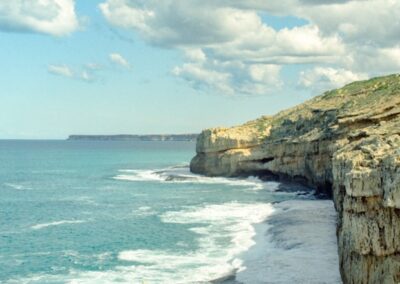
The rugged coastline of the Great Australian Bight, where the Bunda Cliffs – the longest, most uninterrupted line of sea cliffs in the world – plunge into a churning, sapphire-blue sea.
-
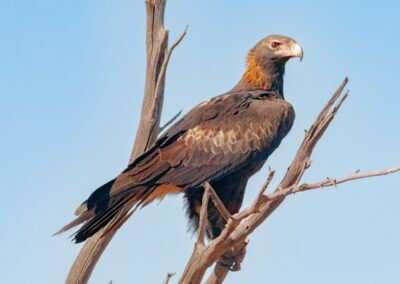
The Wedge-tailed Eagle, a magnificent, resourceful, and occasionally road-kill-scavenging monarch of the outback skies.
Part 4: The Wild West
Our push into the Wild West delivered deafening gold mine tours, a terrifying fuel shortage on a flooded dirt track, and a humiliating retreat from highly aggressive black swans near Wave Rock
-
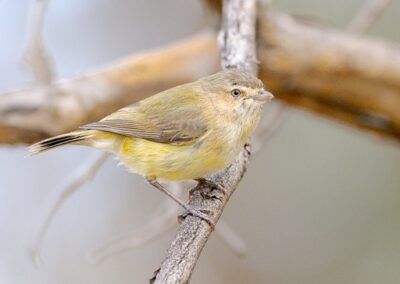
Australia’s smallest bird, the Weebill. A tiny, energetic whisper of life, and a welcome, delicate sight within the raw, industrial landscapes of the Kalgoorlie goldfields.
-
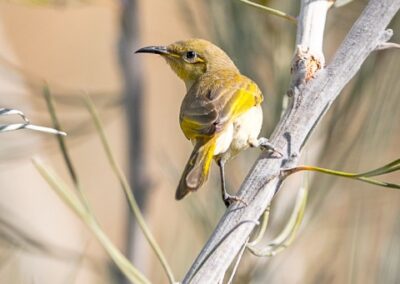
A Brown Honeyeater. Some birdwatching is more glamorous than others, especially when it involves a car fridge and a long, hot journey.
-
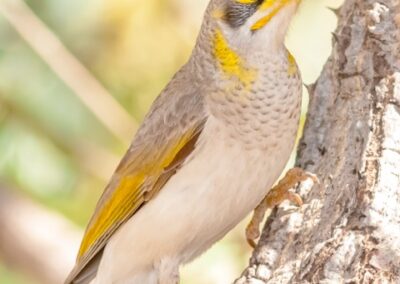
The Yellow-throated Miner, a common sight in the historic goldfields of Western Australia.
-
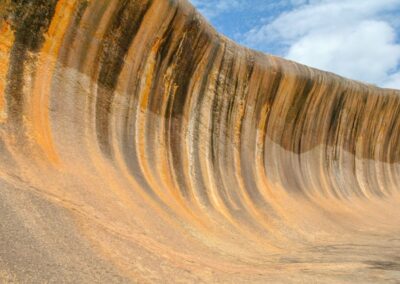
Wave Rock, a 15-metre-high breaking wave of solid granite that looks as though it was ordered from a catalogue of ‘Absurdly Placed Geological Wonders.’ A truly massive and theatrical piece of erosion.
-
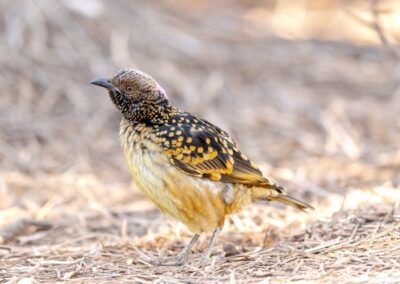
The Western Bowerbird. This one isn’t the art; it’s the artist, a creature that has staked its entire reproductive future on the wholehearted belief that interior design is everything.
-
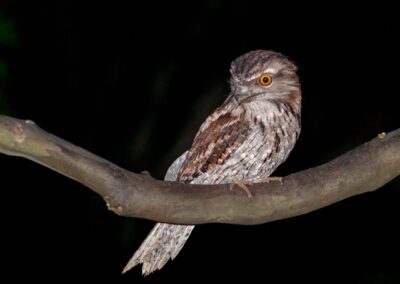
The Tawny Frogmouth, a master of camouflage. Finding one is a triumph; finding two is a cause for celebration.
-
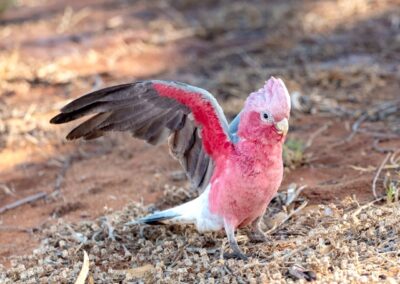
A Galah, a flash of rose-pink and business-like grey, about to engage in its signature last-second liftoff to avoid becoming a bonnet ornament.
-
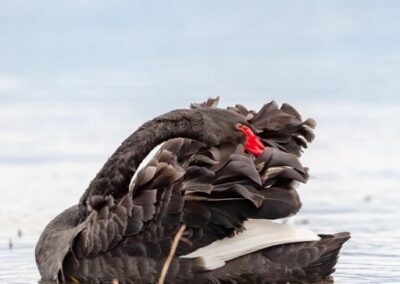
The Black Swan. An elegant icon, until it suspects you have bread. Then it transforms into a savage, hissing horde.
-
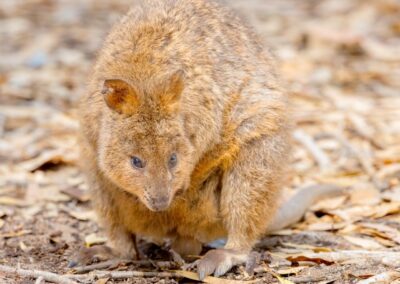
The Quokka of Rottnest Island, a creature seemingly assembled from all the leftover cute bits of the animal kingdom. Their fearlessness is legendary, and they seem to view human visitors as potential friends, or at least, willing photographers.
Part 5: The Northern Exposure (The Long Haul to the Top End)
Leaving the southern coast behind, we survived a putrid esky disaster in Geraldton, marvelled at the ancient gorges of Kalbarri, and somehow avoided catastrophe during a terrifying highway blowout in the oppressive Pilbara heat
-
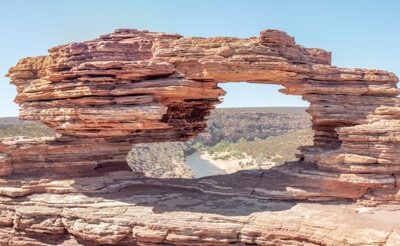
Nature’s Window, a wind-scoured rock frame offering a view of the Murchison River, winding through its vast, rust-red canyon.
-
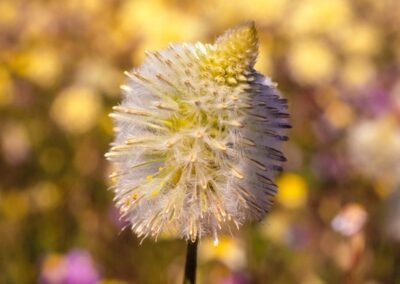
The Green Pussytail, a study in understated elegance. It presents ovoid flower heads of a delicate creamgreen, like tiny, well-groomed paintbrushes left behind by an artist with a penchant for pastels.
-
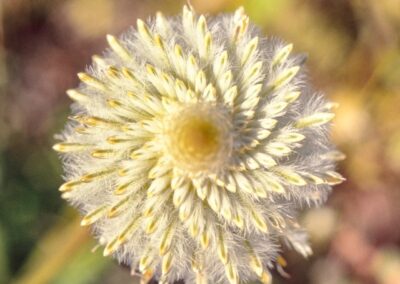
The true magic of the Green Pussytail, revealed only when you peer down from directly above. Its flowerhead is an amazing, almost mathematically precise spiral, as if a tiny, meticulous craftsman decided to arrange each component with a watchmaker’s precision.
-
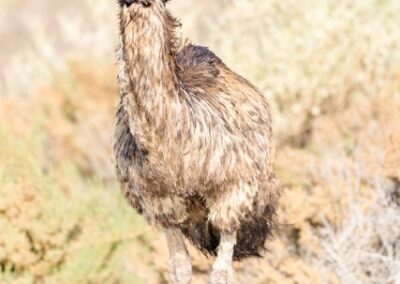
The Emu, a feathered oddity that looks like a haystack on stilts and runs as if it’s just remembered it left the cosmic iron on.
-
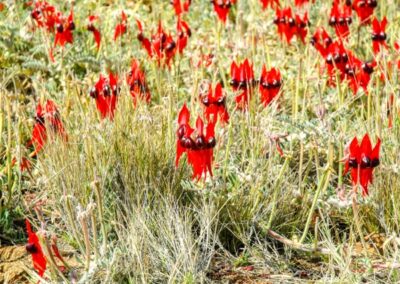
Sturt’s Desert Pea, a defiant splash of crimson joy in a landscape that often defaults to shades of ochre and grey.
-
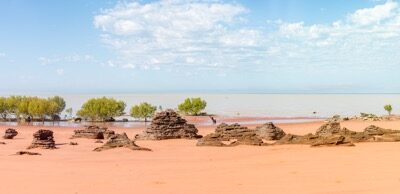
The vast, shallow tidal flats of Roebuck Bay, near the Broome Bird Observatory. A landscape of salt marsh and mangrove mud, where the tide recedes with astonishing speed, leaving a rich feeding ground for waders and a formidable challenge for shore-based anglers.
-
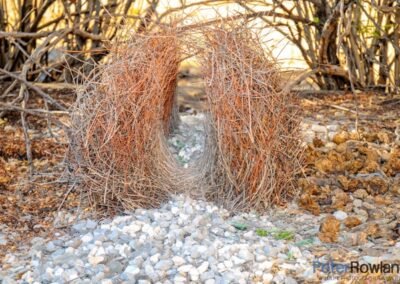
The Great Bowerbird’s creation, a tribute to the fact that sometimes it’s not about how you look, but about how well you can decorate.
-
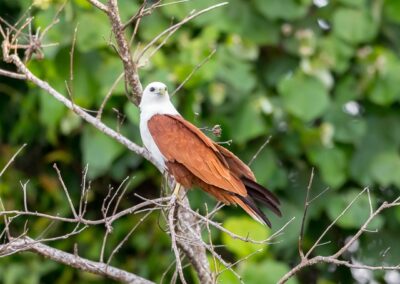
The Brahminy Kite, a striking raptor often seen soaring over the coastal landscapes of northern Australia.
-
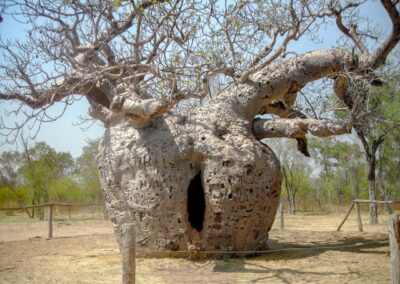
The incredible and well-graffitied Prison Boab Tree, its ancient, swollen trunk a silent witness to a dark chapter of local history.
-
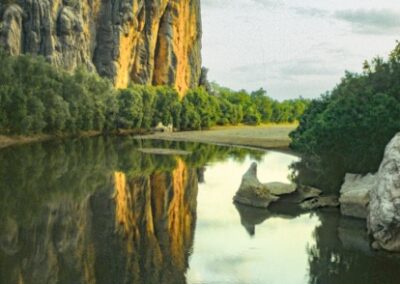
Deep in the Kimberley. The sheer, rust-and-grey walls of Windjana Gorge shadow the Lennard River. An ancient, silent sanctuary teeming with life and freshwater crocodiles, hidden away in the harsh, untamed beauty of the North.
-
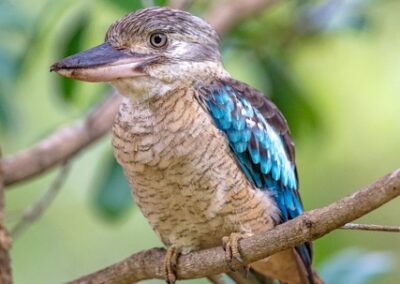
The Blue-winged Kookaburra. Its laugh is more maniacal, less jolly than its southern cousin.
-
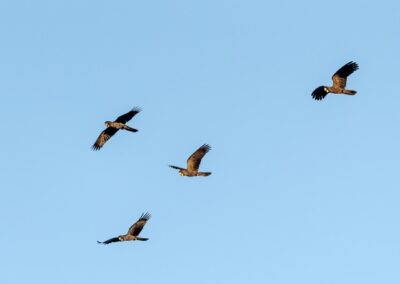
Part of a magnificent, raucous flock of Red-tailed Black-Cockatoos. Their metallic calls and flashes of secret red are a quintessential spectacle of the Kimberley.
Part 6: Heart of the North (The Kimberley, Kakadu, and Katherine)
Crossing into the Northern Territory delivered a frustrating time-zone shift, disappointing hot springs in Katherine, and a sweltering arrival in Darwin, where looming bankruptcy forced us to abandon our Red Centre dreams in favour of the coast
-
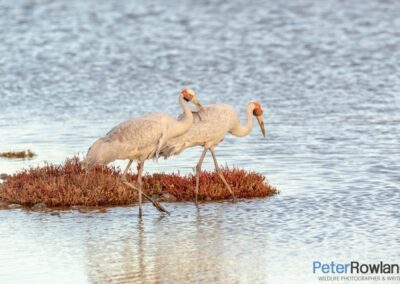
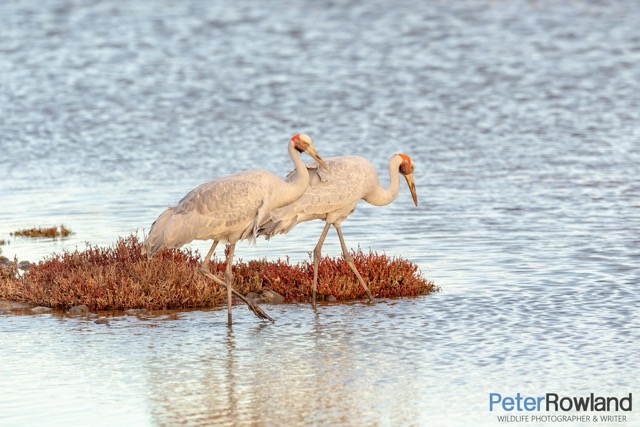
A pair of Brolgas, creatures of such improbable grace and elegance that they seem to have wandered out of a Tchaikovsky ballet and into the wrong hemisphere.
-
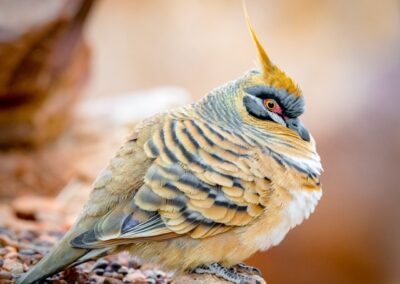
The Spinifex Pigeon, a master of camouflage, perfectly blending with the red earth and sandstone escarpments of the outback.
-
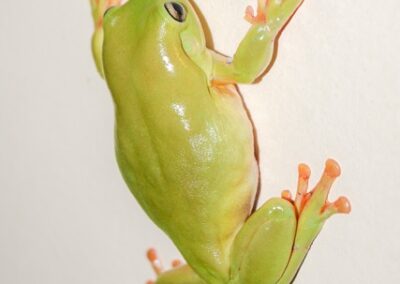
The Green Tree Frog, a robust character and connoisseur of damp, cool real estate, often found in the most unexpected of places.
-
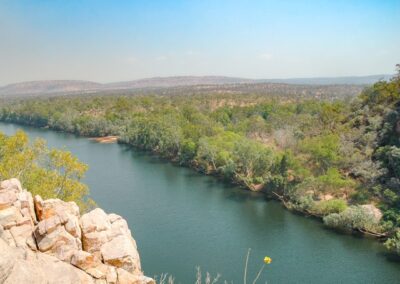
The view from the lookout over Katherine Gorge. After missing the last boat cruise of the day, a hot, dusty walk was rewarded with this magnificent vista of turquoise water winding between towering red cliffs.
-
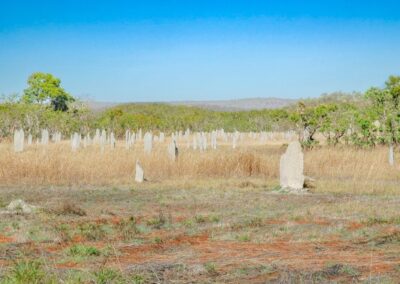
A field of Magnetic Termite mounds, a silent, sun-worshipping city of insects that has, quite literally, got its priorities straight. Each one, with an eerie consistency, aligns its main axis north-south.
-
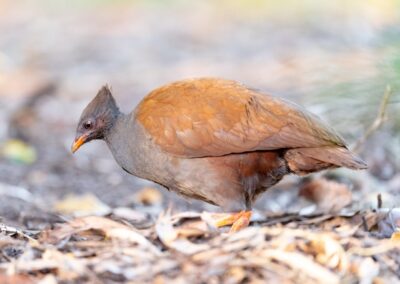
The Orange-footed Scrubfowl. Its loud, raucous calls often echo through the Top End woodlands long before you spot the bird itself, scratching purposefully in the undergrowth.
-
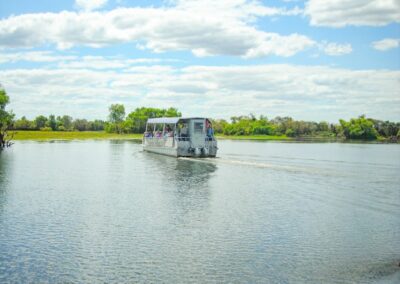
The Yellow Water cruise. The flat-bottomed boat that felt like a fortress of reassuring safety as we nosed through a landscape that felt less like the 21st century and more like a misplaced Jurassic theme park.
-
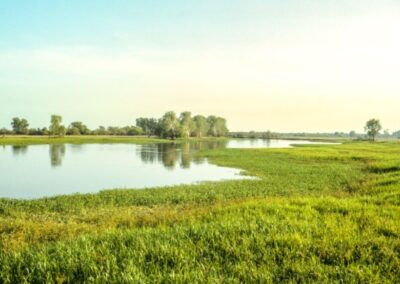
The Yellow Water cruise. It might look tempting for a quick dip, but you won't need a towel
-
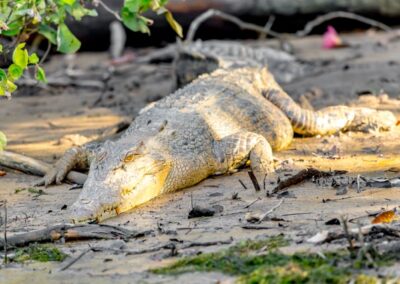
A Saltwater Crocodile, or ‘Salty,’ basking on a mud bank. Spotting your first one is less an ‘Aha!’ moment and more a slow, dawning realisation that a particularly gnarled, mud-caked log has, in fact, got eyes. And teeth. Lots of teeth.
-
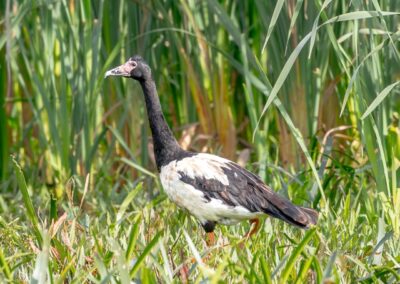
A Magpie Goose, one of the many inhabitants of the rich wetlands of the Top End. They gather in their thousands on the Kakadu floodplains, their distinctive honking calls a constant, noisy soundtrack to the landscape.
-
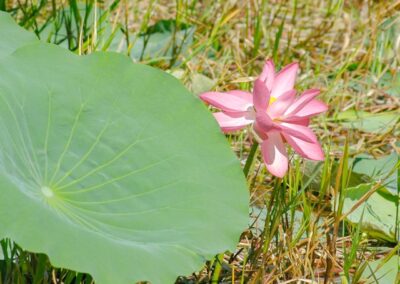
The Red Lily, or Lotus Flower, its enormous leaves and fragrant pink flowers creating a floating tapestry of green and pink on a northern billabong. The same plant whose seeds and leaves the great Malcolm Douglas suggested could be eaten or worn as a hat – survival tips that seemed rather understated when surrounded by man-eating crocodiles.
-
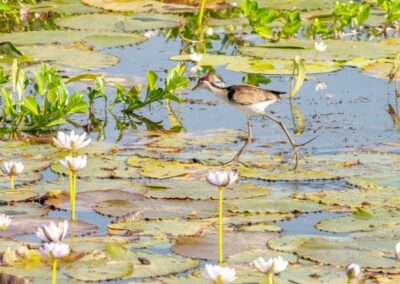
The Comb-crested Jacana, aptly nicknamed the ‘Jesus Bird’. Watching it in Kakadu was a marvel, as it delicately picked its way across the water lilies, its impossibly long toes distributing its weight so perfectly it looked as though it was walking on water.
-
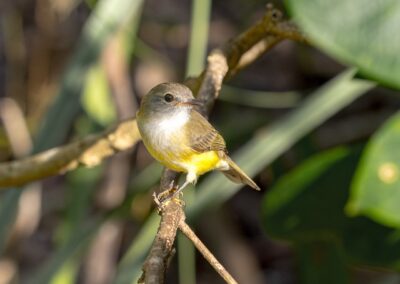
The Lemon-bellied Flycatcher, a small but vibrant inhabitant of the northern woodlands.
-
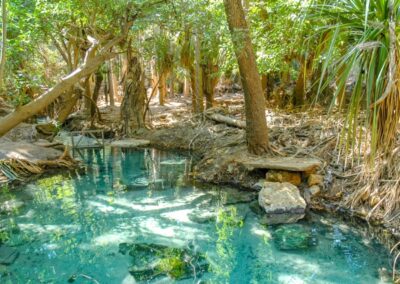
The crystal-clear thermal pool at Mataranka, a balmy 34 °C oasis in the heart of the ‘Never Never’ country. Soaking in the naturally heated water, surrounded by lush pandanus and palms, was a truly delightful and therapeutic experience after a long, hot drive.
-
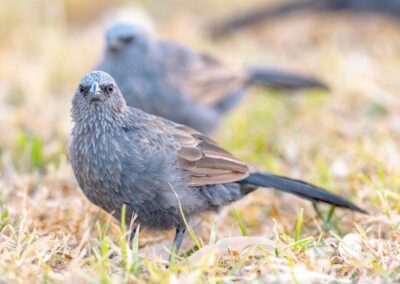
The Apostlebird. Seeing a flock of these sociable, chattering birds always feels like a good omen.
Part 7: The Race East (The Road to Queensland)
Leaving the Northern Territory, we survived terrifying, speed-limit-free highways and road trains before camping under a spectacular outback sky, where we enjoyed a karmic chuckle at a pompous tourist pitching his swag on an ants’ nest
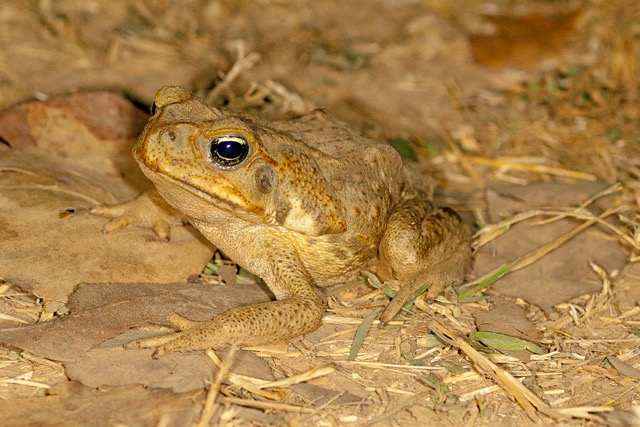
The infamous Cane Toad. Despite their reputation for being everywhere they’re not wanted, they remained stubbornly ‘on holiday’ for the duration of our trip.
Part 8: The Homestretch (The Queensland Coast to Sydney)
The final leg down the East Coast delivered pungent rum tours, a macabre shark show, and a miraculous, oversized parcel of fish and chips that restored our road-weary spirits in Hervey Bay
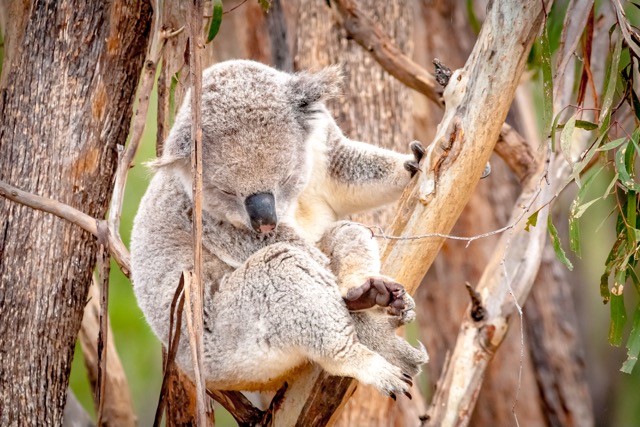
A sleeping Koala, the picture of eucalyptus-fuelled innocence. This one looks peaceful enough, but I was mauled by a more awake, and decidedly more savage, one of these. They look cuddly. They are not.
Part 1: The Great Escape
Our 1992 odyssey began with a frantic, pre-dawn departure from Sydney that was immediately derailed by a leaking trailer and a freezing, 980-kilometre dash to the Victorian coast
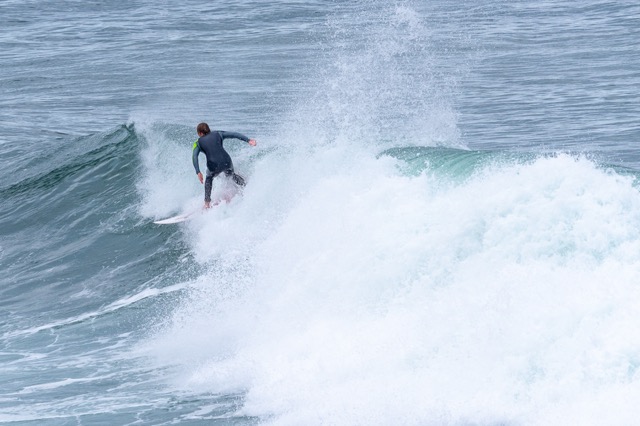
A lone surfer braves the ‘brass monkeys’ cold. His skill was impressive; my desire to join him was non-existent.
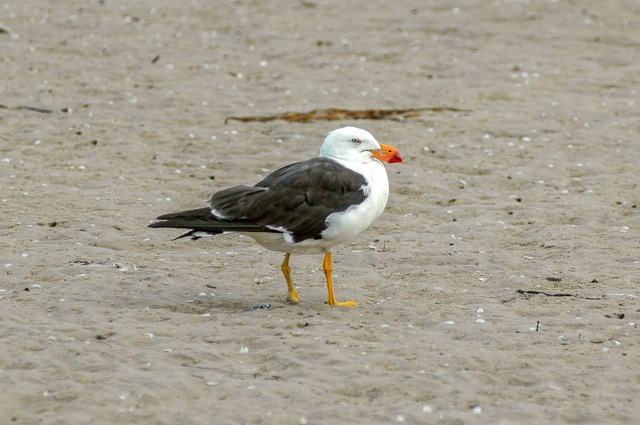
A Pacific Gull, eyeing me with professional disinterest. It was, as I noted at the time, ‘bloody cold for that’.
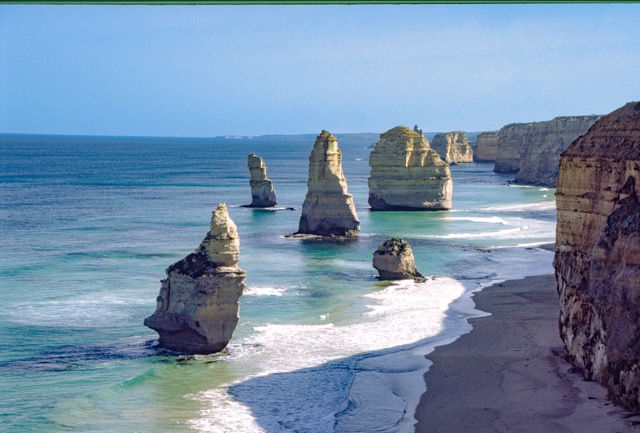
The magnificent Twelve Apostles, standing defiant against the relentless Southern Ocean. Or, as they should perhaps be more accurately named, the ‘Nine Remaining Disciples Who Haven’t Yet Succumbed to the Inevitable.’
Part 2: South Australia (Whales, Watermelons and Wrong Turns)
Our South Australian leg offered a brief reprieve with subterranean cave explorations and vivid blue lakes, though confusing time zones and relentless drizzle soon complicated our progress
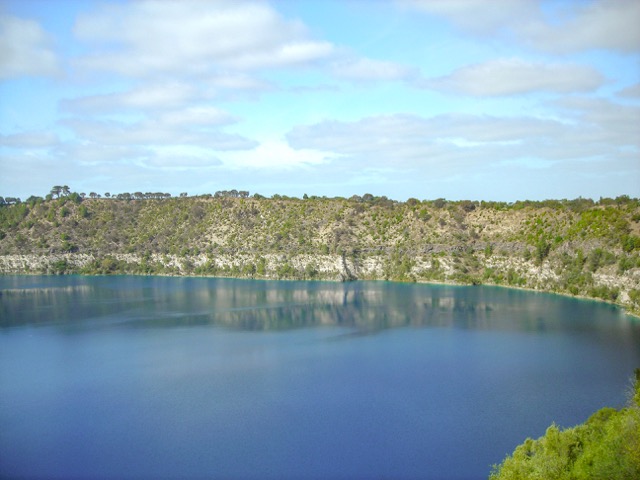
The famous Blue Lake at Mount Gambier. It was decidedly more blue-grey, and ‘wintery’ when I first saw it.
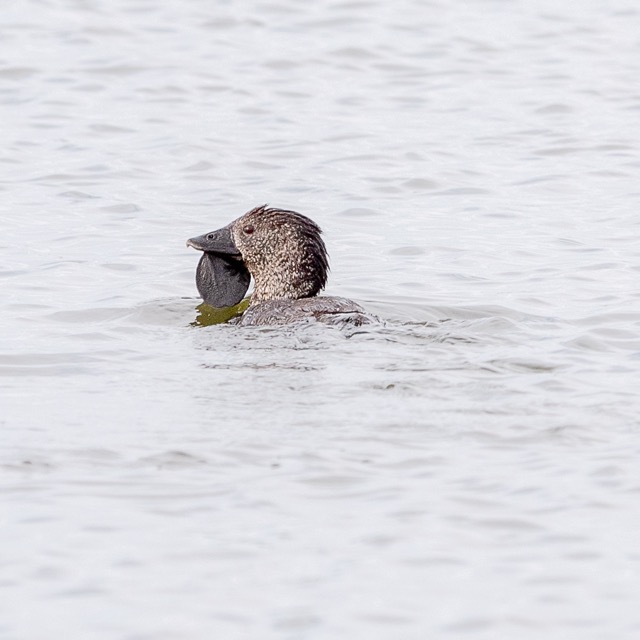
The Musk Duck, a bird that throws conventional elegance out the window, stomps on it with its webbed feet, and then proudly inflates a large, leathery neck-gobble in its general direction.
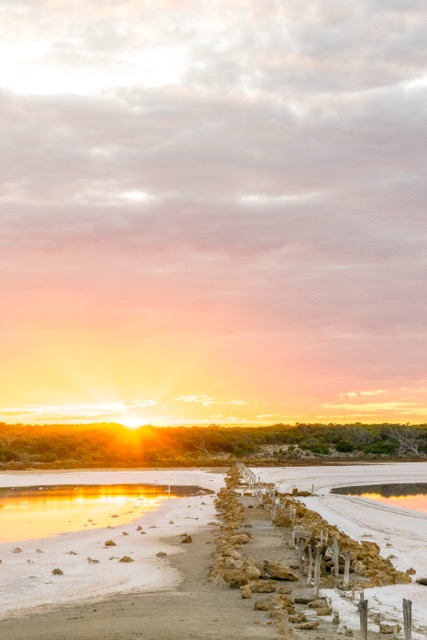
The vast, shallow salt lakes of the Coorong. A landscape of serene lagoons and windswept dunes that, on our visit, was viewed through a curtain of relentless, soul-sapping drizzle.
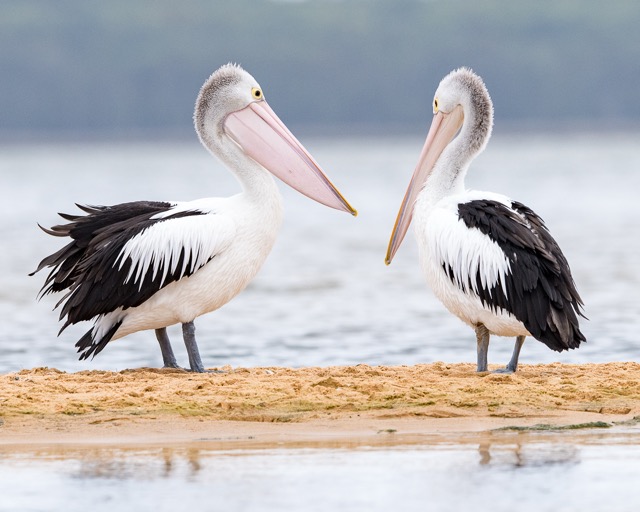
The Australian Pelican, a bird designed on a grand, slightly prehistoric scale. Its enormous, pouched appendage isn’t so much a beak as a built-in, expandable shopping basket.
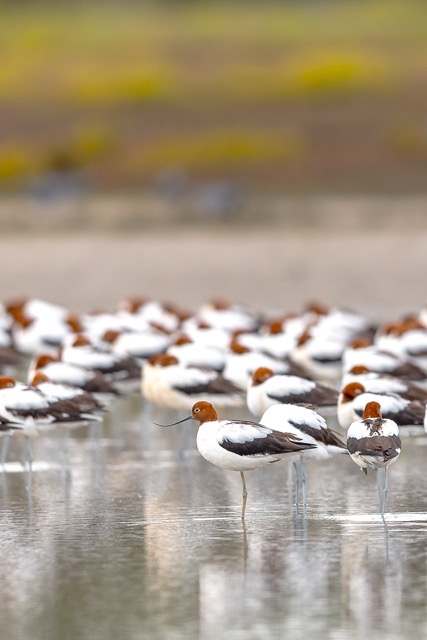
The Red-necked Avocet, its long, impossibly thin bill elegantly upturned at the tip. A moment of delicate beauty in an often damp and dreary landscape.
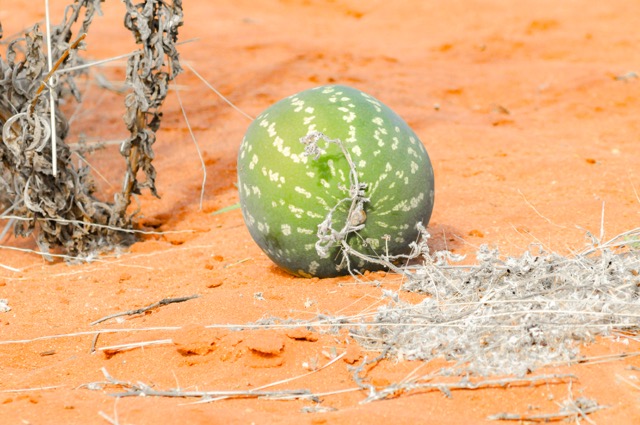
The Paddy Melon, an invasive species whose seeds were spread by early camel trains. Caution is advised; eating one could lead to a rather unpleasant, and historically significant, stomach ache.
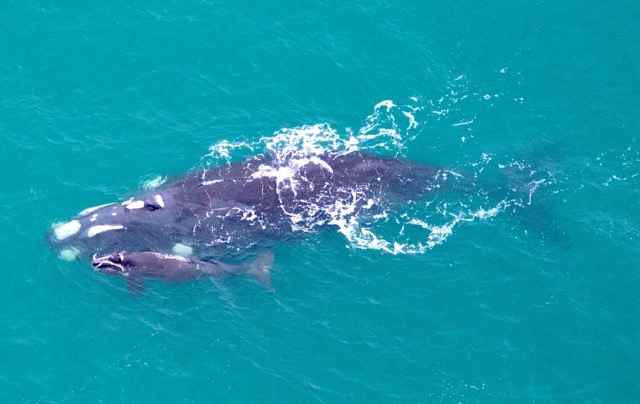
A Southern Right Whale mother and her calf in tranquil southern waters. A moment of pure, unadulterated magic – one you hope you have enough film for [image © Chris Farrell].
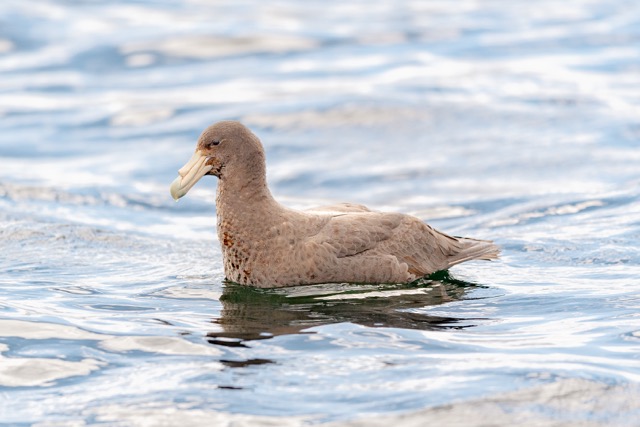
The one-footed Southern Giant Petrel was a highlight at Victor Harbor. For me, an even greater thrill than the whales. A true wanderer of the Southern Ocean, and a stoic inspiration.
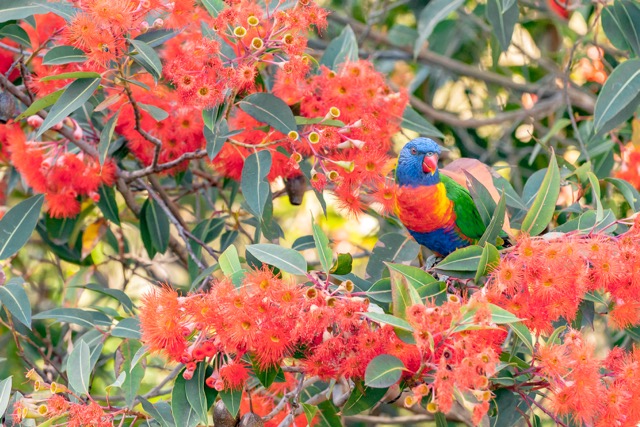
The Rainbow Lorikeet, a bird that looks as though it flew through a paint factory during a particularly violent explosion.
Part 3: The Nullarbor Plain (Halfway Across Australia)
Leaving civilisation behind, we braved the terrifying road trains of the Eyre Highway and camped on a literal ‘bed of nails’ in Kimba before enduring bone-jarring corrugated tracks to view Australian Sea Lions
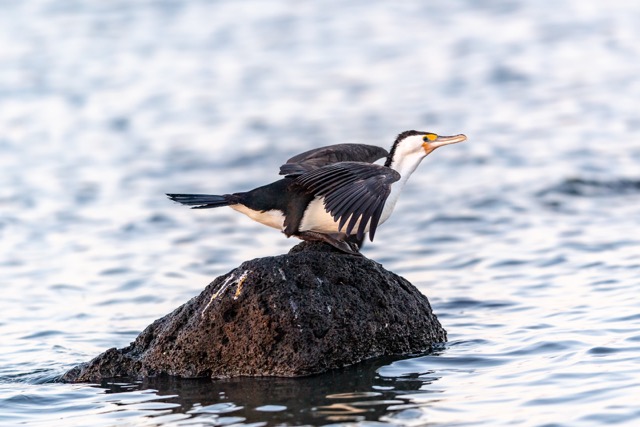
The Australian Pied Cormorant. A classic sight, and often the subject of photographic regret when the long lens is left in the car.
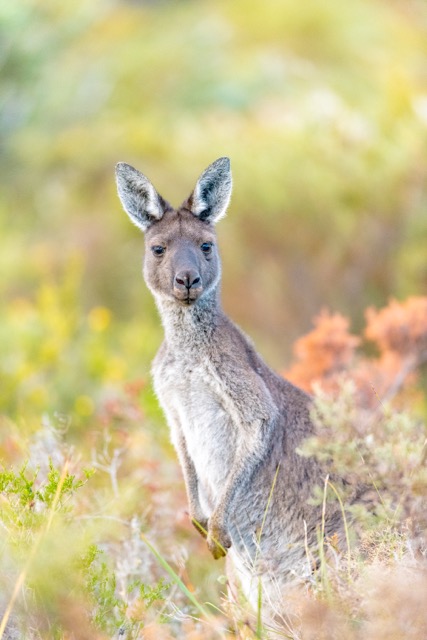
The Western Grey Kangaroo, a creature that seemed to have missed the memo about being a national icon and had instead opted for the persona of a large, long-tailed rabbit deep in thought about a crossword puzzle.
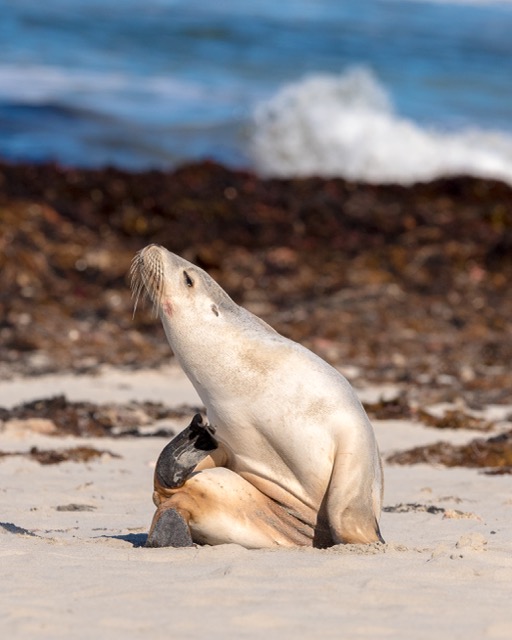
The Australian Sea Lion, a creature of undeniable, almost goofy charisma. Dubbed the ‘puppies of the sea,’ they are fantastically playful and seem to view human visitors with a friendly, inquisitive charm.
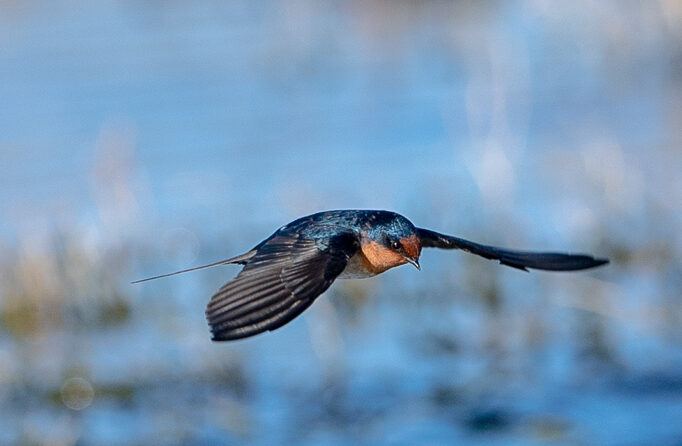
A Welcome Swallow. Their aerial acrobatics signal home… even when you’re thousands of kilometres away from it.
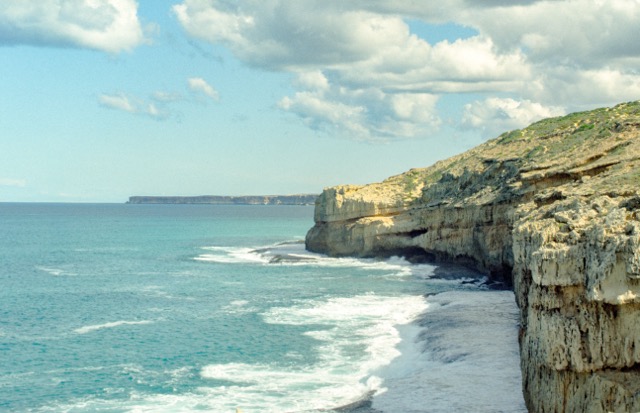
The rugged coastline of the Great Australian Bight, where the Bunda Cliffs – the longest, most uninterrupted line of sea cliffs in the world – plunge into a churning, sapphire-blue sea.
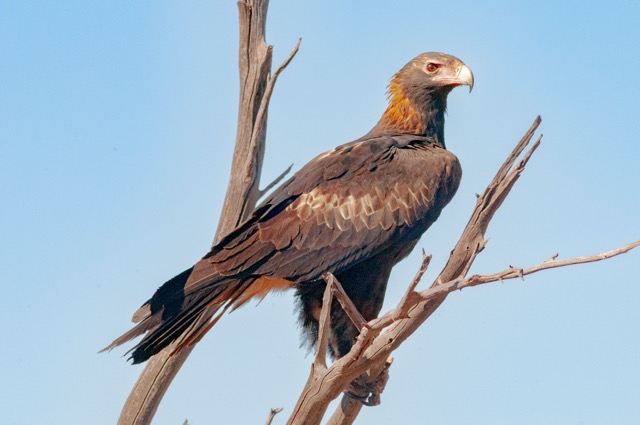
The Wedge-tailed Eagle, a magnificent, resourceful, and occasionally road-kill-scavenging monarch of the outback skies.
Part 4: The Wild West
Our push into the Wild West delivered deafening gold mine tours, a terrifying fuel shortage on a flooded dirt track, and a humiliating retreat from highly aggressive black swans near Wave Rock
Australia’s smallest bird, the Weebill. A tiny, energetic whisper of life, and a welcome, delicate sight within the raw, industrial landscapes of the Kalgoorlie goldfields.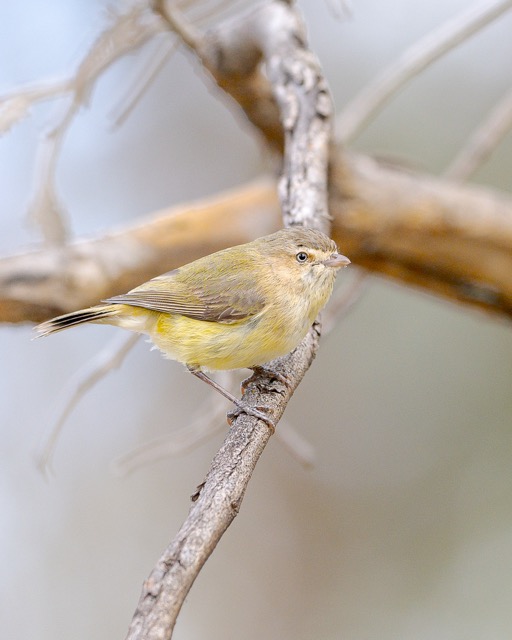
A Brown Honeyeater. Some birdwatching is more glamorous than others, especially when it involves a car fridge and a long, hot journey.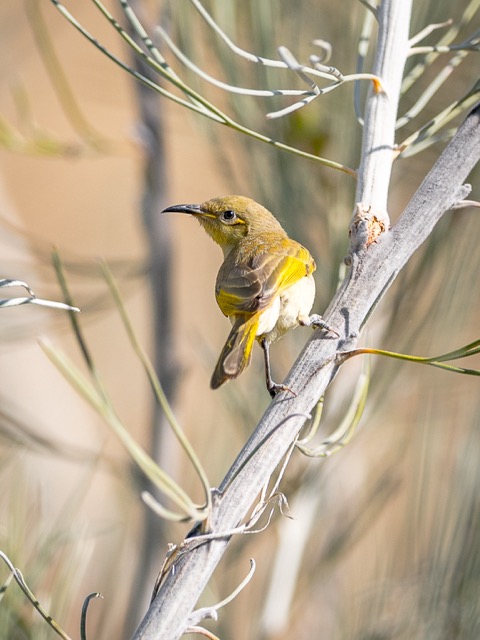
The Yellow-throated Miner, a common sight in the historic goldfields of Western Australia.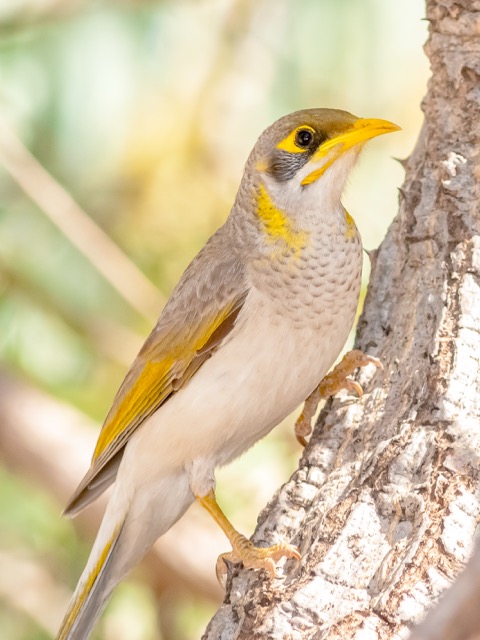
Wave Rock, a 15-metre-high breaking wave of solid granite that looks as though it was ordered from a catalogue of ‘Absurdly Placed Geological Wonders.’ A truly massive and theatrical piece of erosion.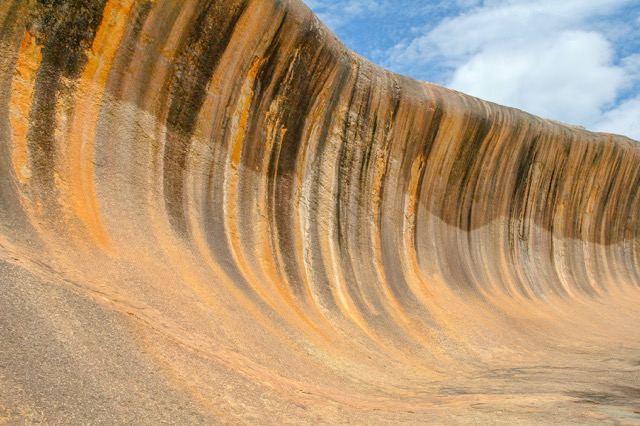
The Western Bowerbird. This one isn’t the art; it’s the artist, a creature that has staked its entire reproductive future on the wholehearted belief that interior design is everything.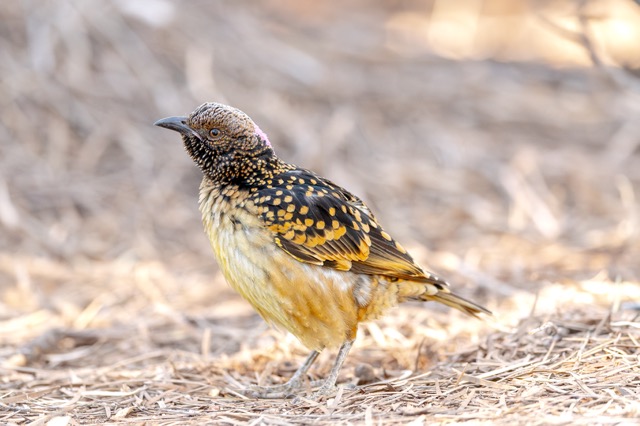
The Tawny Frogmouth, a master of camouflage. Finding one is a triumph; finding two is a cause for celebration.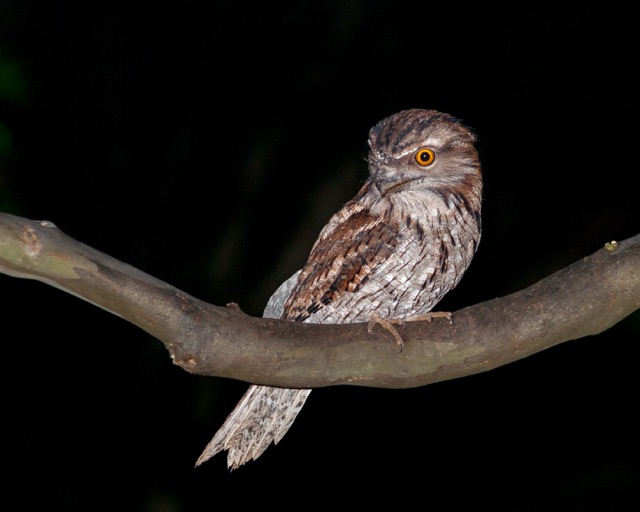
A Galah, a flash of rose-pink and business-like grey, about to engage in its signature last-second liftoff to avoid becoming a bonnet ornament.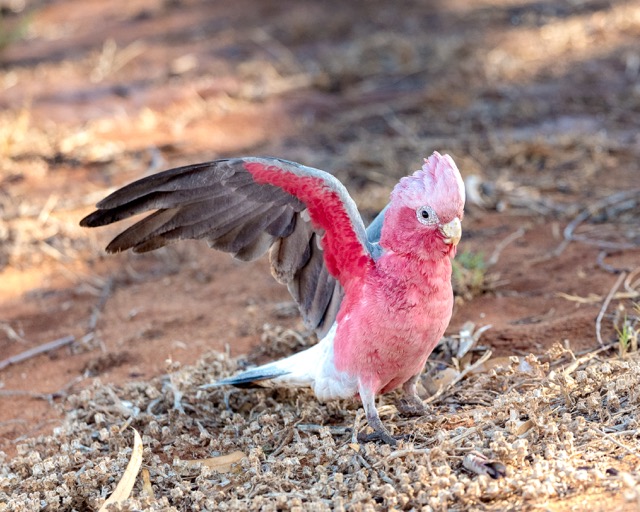
The Black Swan. An elegant icon, until it suspects you have bread. Then it transforms into a savage, hissing horde.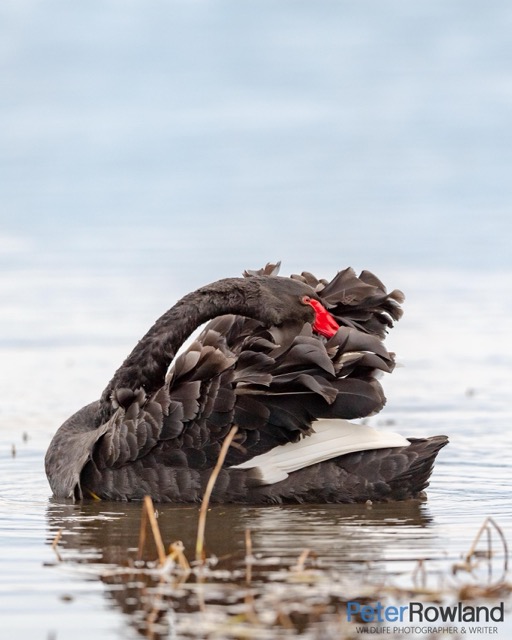
The Quokka of Rottnest Island, a creature seemingly assembled from all the leftover cute bits of the animal kingdom. Their fearlessness is legendary, and they seem to view human visitors as potential friends, or at least, willing photographers.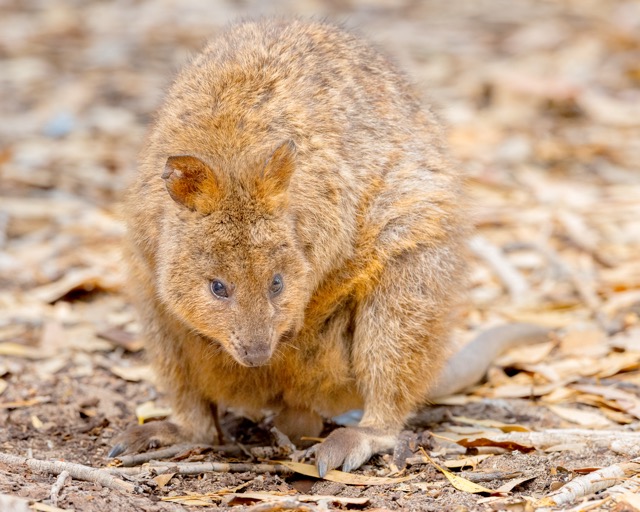
Part 5: The Northern Exposure (The Long Haul to the Top End)
Leaving the southern coast behind, we survived a putrid esky disaster in Geraldton, marvelled at the ancient gorges of Kalbarri, and somehow avoided catastrophe during a terrifying highway blowout in the oppressive Pilbara heat
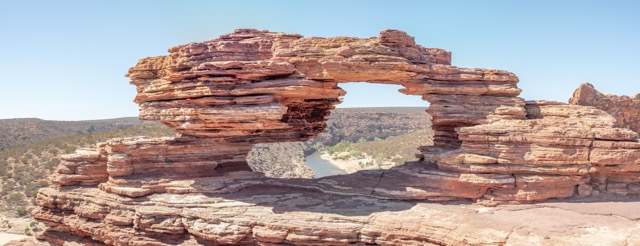
Nature’s Window, a wind-scoured rock frame offering a view of the Murchison River, winding through its vast, rust-red canyon.
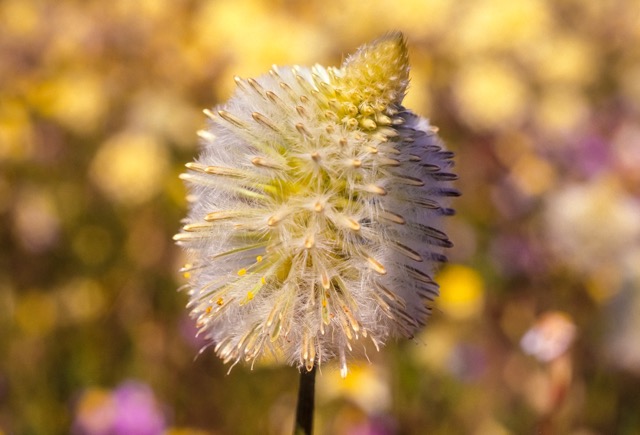
The Green Pussytail, a study in understated elegance. It presents ovoid flower heads of a delicate creamgreen, like tiny, well-groomed paintbrushes left behind by an artist with a penchant for pastels.
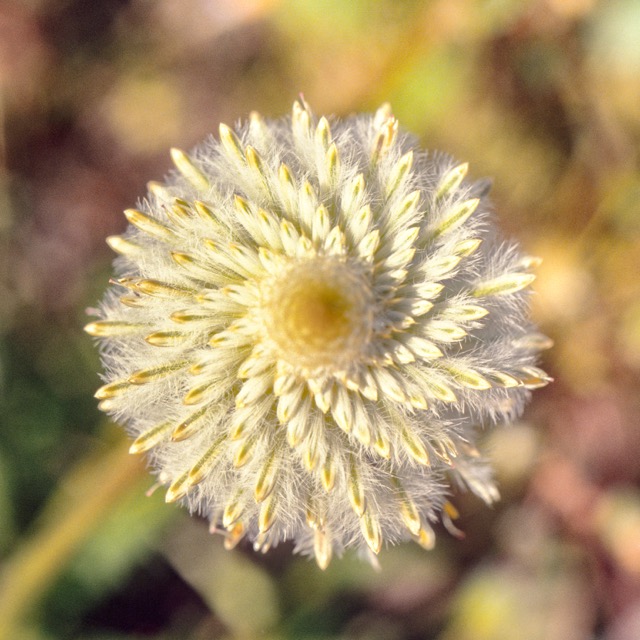
The true magic of the Green Pussytail, revealed only when you peer down from directly above. Its flowerhead is an amazing, almost mathematically precise spiral, as if a tiny, meticulous craftsman decided to arrange each component with a watchmaker’s precision.
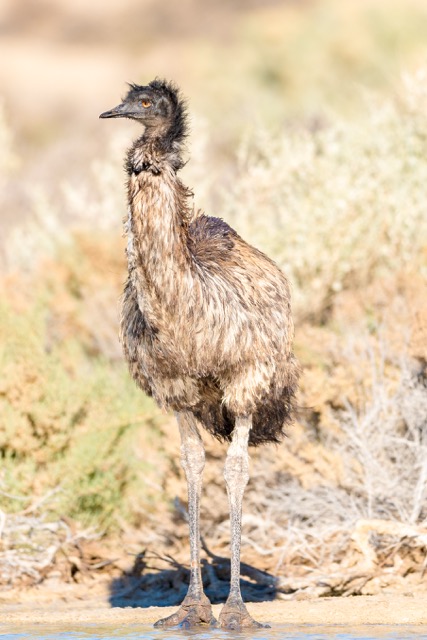
The Emu, a feathered oddity that looks like a haystack on stilts and runs as if it’s just remembered it left the cosmic iron on.
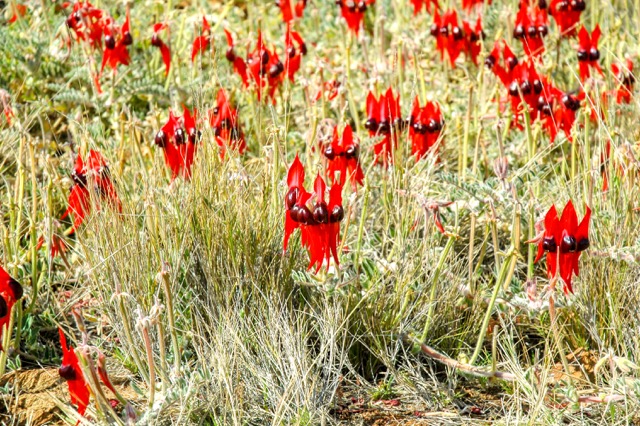
Sturt’s Desert Pea, a defiant splash of crimson joy in a landscape that often defaults to shades of ochre and grey.
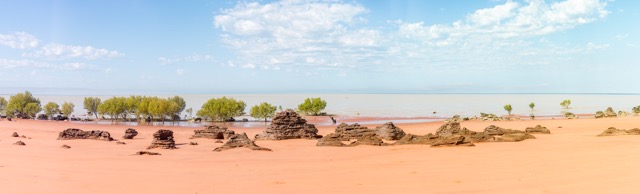
The vast, shallow tidal flats of Roebuck Bay, near the Broome Bird Observatory. A landscape of salt marsh and mangrove mud, where the tide recedes with astonishing speed, leaving a rich feeding ground for waders and a formidable challenge for shore-based anglers.
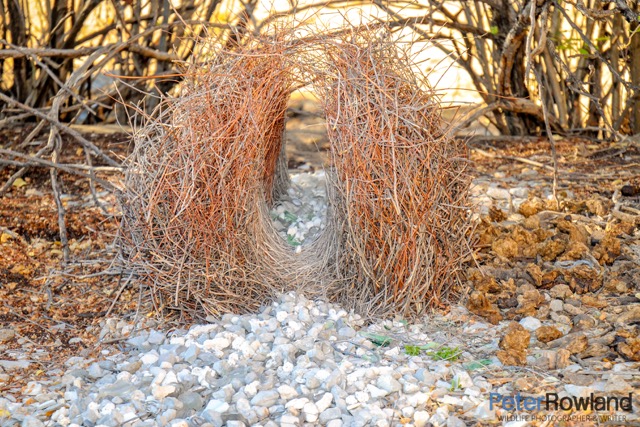
The Great Bowerbird’s creation, a tribute to the fact that sometimes it’s not about how you look, but about how well you can decorate.
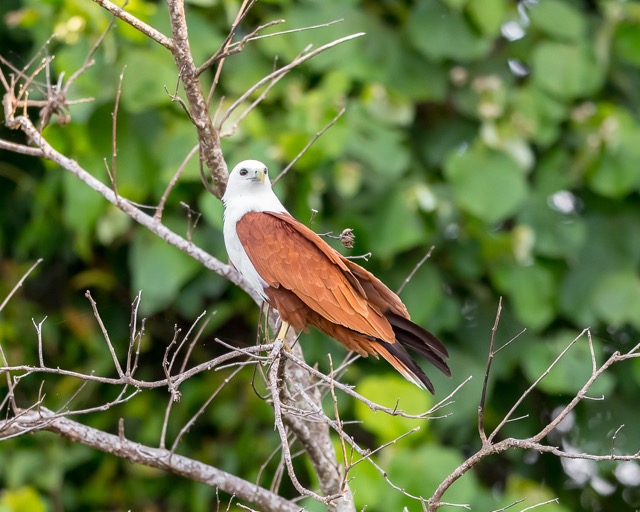
The Brahminy Kite, a striking raptor often seen soaring over the coastal landscapes of northern Australia.
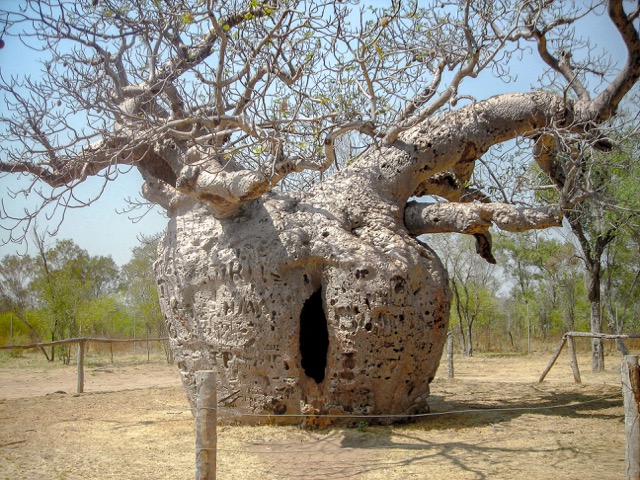
The incredible and well-graffitied Prison Boab Tree, its ancient, swollen trunk a silent witness to a dark chapter of local history.
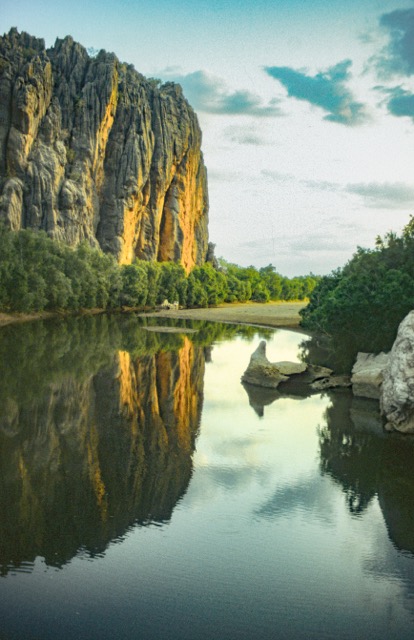
Deep in the Kimberley. The sheer, rust-and-grey walls of Windjana Gorge shadow the Lennard River. An ancient, silent sanctuary teeming with life and freshwater crocodiles, hidden away in the harsh, untamed beauty of the North.
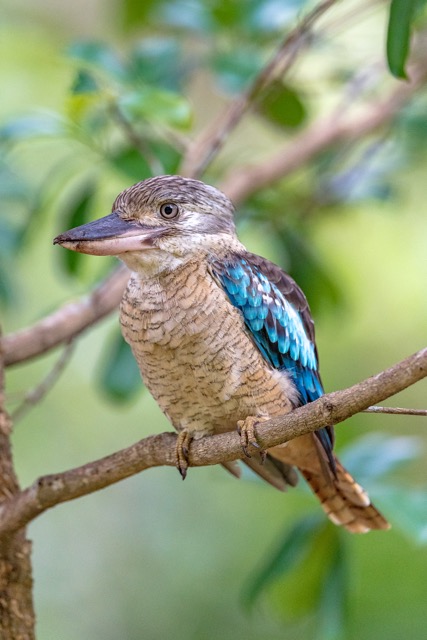
The Blue-winged Kookaburra. Its laugh is more maniacal, less jolly than its southern cousin.
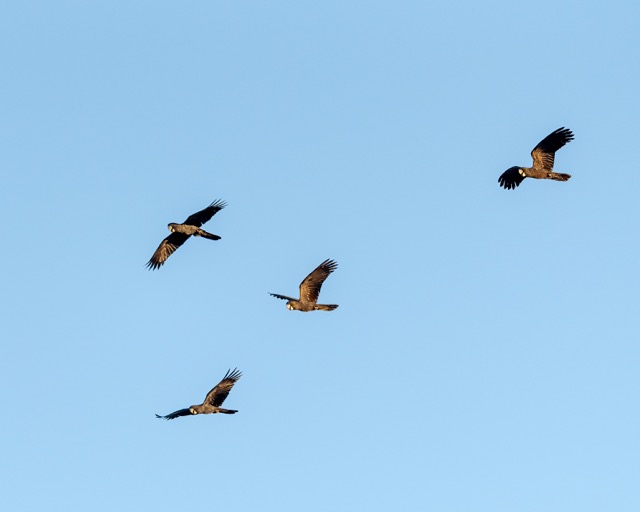
Part of a magnificent, raucous flock of Red-tailed Black-Cockatoos. Their metallic calls and flashes of secret red are a quintessential spectacle of the Kimberley.
Part 6: Heart of the North (The Kimberley, Kakadu, and Katherine)
Crossing into the Northern Territory delivered a frustrating time-zone shift, disappointing hot springs in Katherine, and a sweltering arrival in Darwin, where looming bankruptcy forced us to abandon our Red Centre dreams in favour of the coast
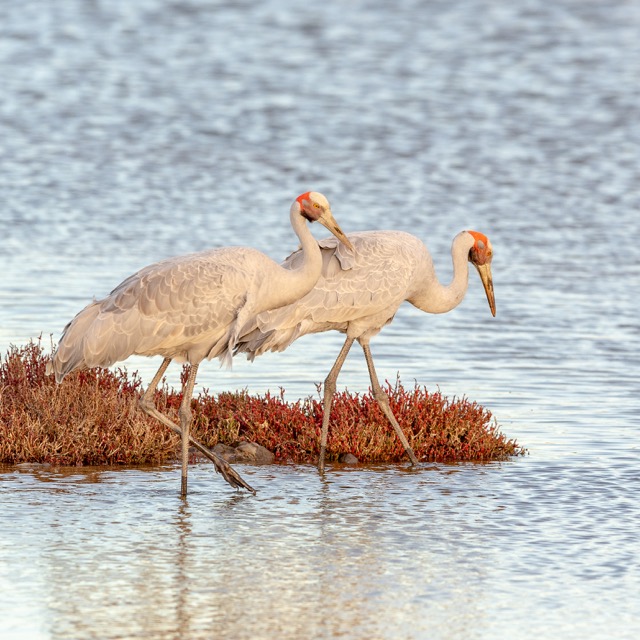
A pair of Brolgas, creatures of such improbable grace and elegance that they seem to have wandered out of a Tchaikovsky ballet and into the wrong hemisphere.
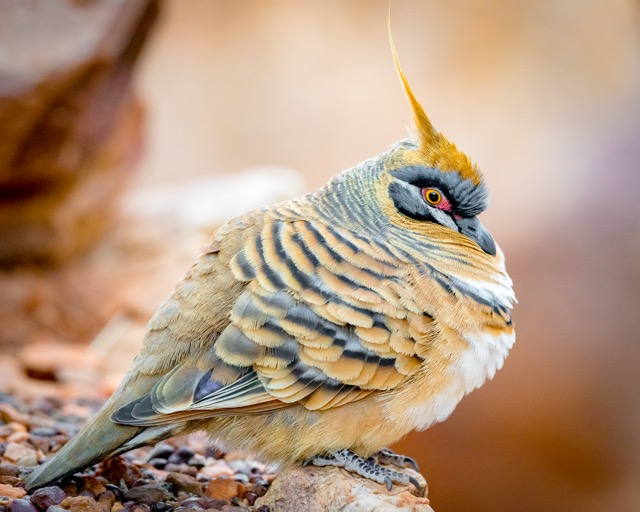
The Spinifex Pigeon, a master of camouflage, perfectly blending with the red earth and sandstone escarpments of the outback.
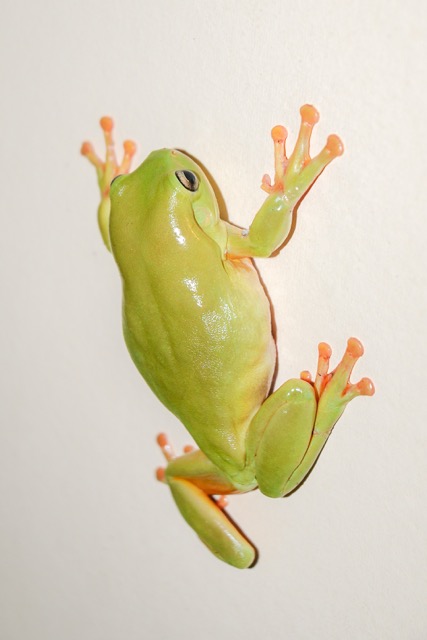
The Green Tree Frog, a robust character and connoisseur of damp, cool real estate, often found in the most unexpected of places.
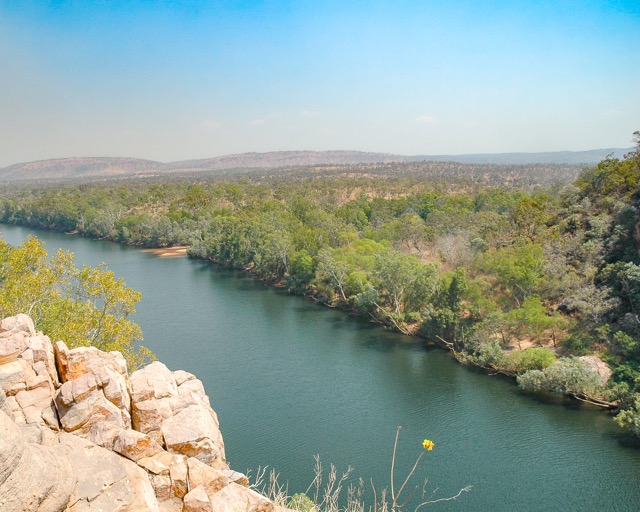
The view from the lookout over Katherine Gorge. After missing the last boat cruise of the day, a hot, dusty walk was rewarded with this magnificent vista of turquoise water winding between towering red cliffs.
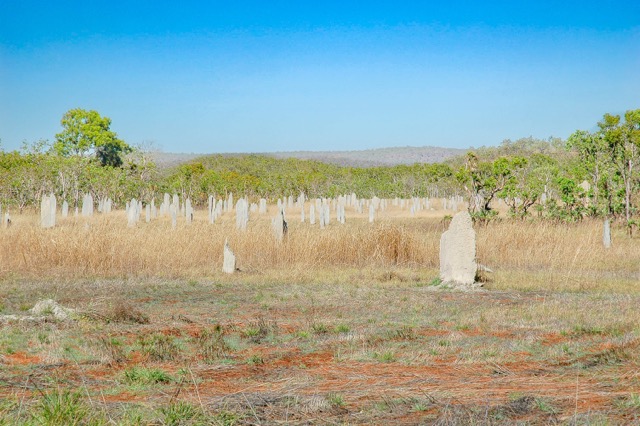
A field of Magnetic Termite mounds, a silent, sun-worshipping city of insects that has, quite literally, got its priorities straight. Each one, with an eerie consistency, aligns its main axis north-south.
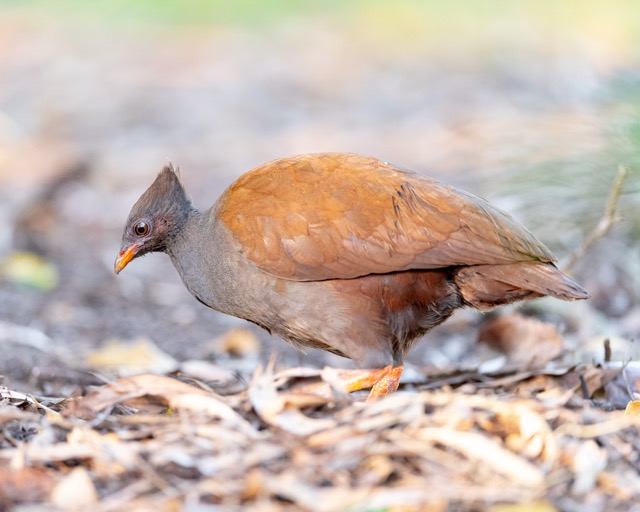
The Orange-footed Scrubfowl. Its loud, raucous calls often echo through the Top End woodlands long before you spot the bird itself, scratching purposefully in the undergrowth.
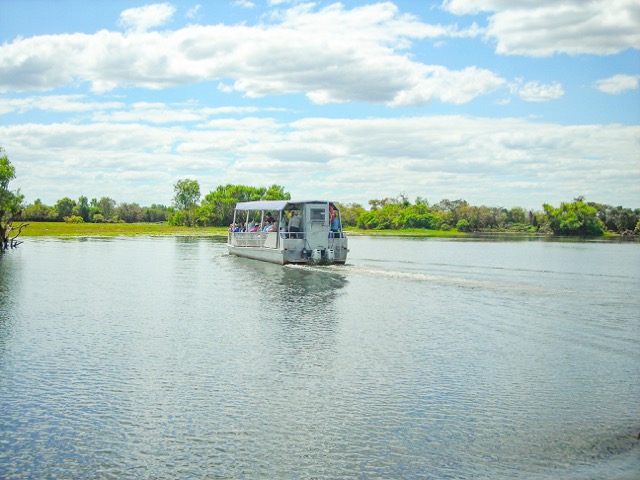
The Yellow Water cruise. The flat-bottomed boat that felt like a fortress of reassuring safety as we nosed through a landscape that felt less like the 21st century and more like a misplaced Jurassic theme park.
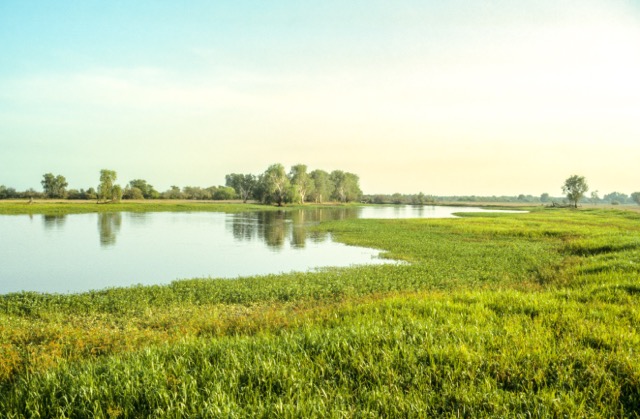
The Yellow Water cruise. It might look tempting for a quick dip, but you won’t need a towel
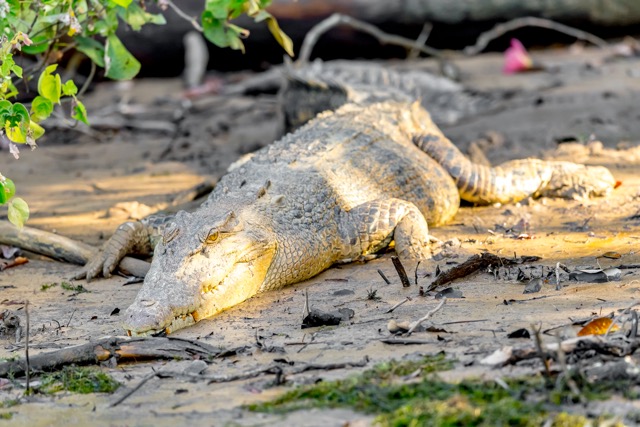
A Saltwater Crocodile, or ‘Salty,’ basking on a mud bank. Spotting your first one is less an ‘Aha!’ moment and more a slow, dawning realisation that a particularly gnarled, mud-caked log has, in fact, got eyes. And teeth. Lots of teeth.
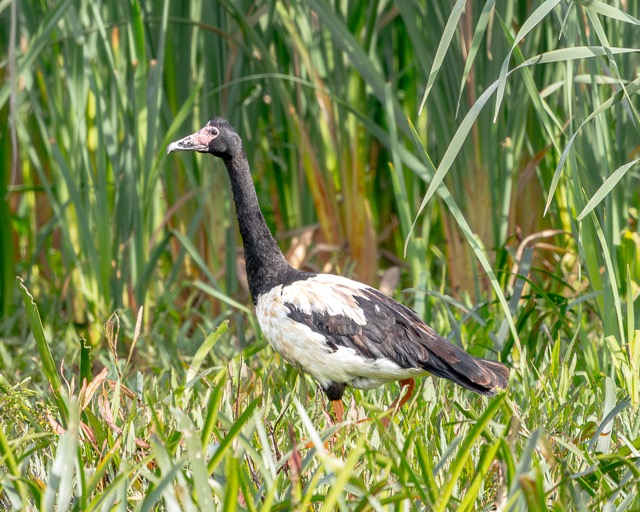
A Magpie Goose, one of the many inhabitants of the rich wetlands of the Top End. They gather in their thousands on the Kakadu floodplains, their distinctive honking calls a constant, noisy soundtrack to the landscape.
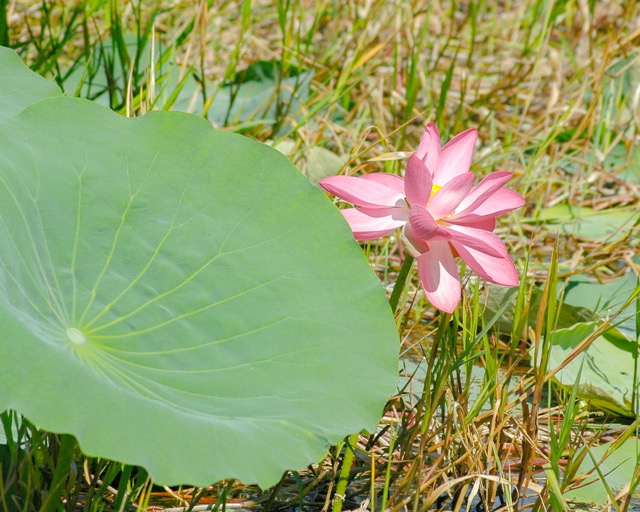
The Red Lily, or Lotus Flower, its enormous leaves and fragrant pink flowers creating a floating tapestry of green and pink on a northern billabong. The same plant whose seeds and leaves the great Malcolm Douglas suggested could be eaten or worn as a hat – survival tips that seemed rather understated when surrounded by man-eating crocodiles.
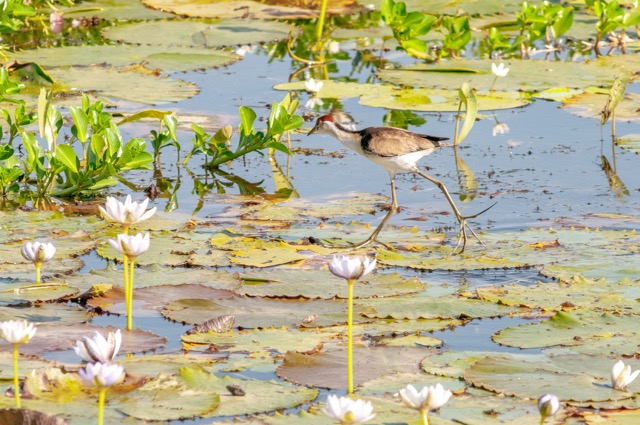
The Comb-crested Jacana, aptly nicknamed the ‘Jesus Bird’. Watching it in Kakadu was a marvel, as it delicately picked its way across the water lilies, its impossibly long toes distributing its weight so perfectly it looked as though it was walking on water.
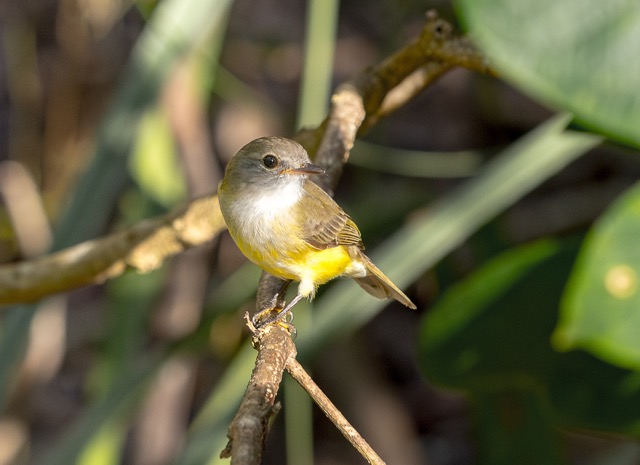
The Lemon-bellied Flycatcher, a small but vibrant inhabitant of the northern woodlands.
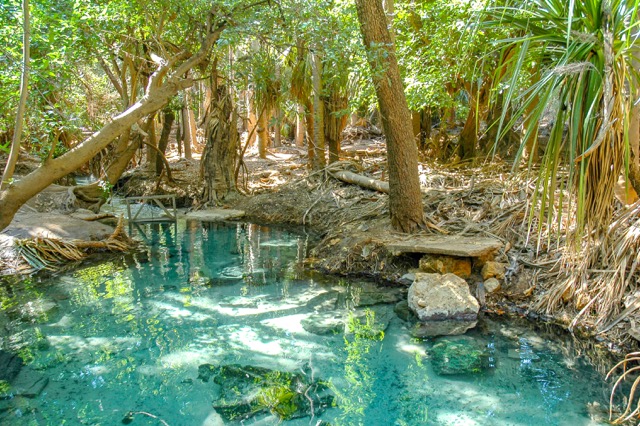
The crystal-clear thermal pool at Mataranka, a balmy 34 °C oasis in the heart of the ‘Never Never’ country. Soaking in the naturally heated water, surrounded by lush pandanus and palms, was a truly delightful and therapeutic experience after a long, hot drive.
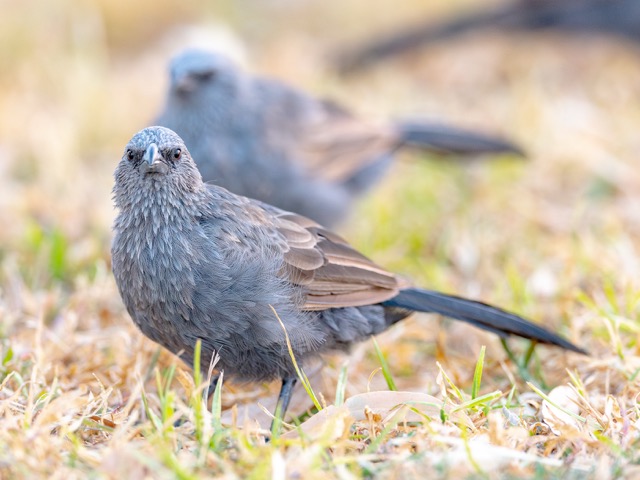
The Apostlebird. Seeing a flock of these sociable, chattering birds always feels like a good omen.
Part 7: The Race East (The Road to Queensland)
Leaving the Northern Territory, we survived terrifying, speed-limit-free highways and road trains before camping under a spectacular outback sky, where we enjoyed a karmic chuckle at a pompous tourist pitching his swag on an ants’ nest
The infamous Cane Toad. Despite their reputation for being everywhere they’re not wanted, they remained stubbornly ‘on holiday’ for the duration of our trip.
Part 8: The Homestretch (The Queensland Coast to Sydney)
The final leg down the East Coast delivered pungent rum tours, a macabre shark show, and a miraculous, oversized parcel of fish and chips that restored our road-weary spirits in Hervey Bay
A sleeping Koala, the picture of eucalyptus-fuelled innocence. This one looks peaceful enough, but I was mauled by a more awake, and decidedly more savage, one of these. They look cuddly. They are not.
⭐⭐⭐⭐⭐
5.0 Stars on Amazon
“A wonderful read. So many interesting and bizarre place names… Makes Moose Jaw, Saskatchewan seem pretty dull!”
— Reader Review
Collectors Print Edition
Experience the journey with colour images.
✓ Signed copies available ✓ Printed on premium paper
✓ Flat-rate shipping across Australia
Digital Ebook
Carry the adventure anywhere.
✓ Instant digital download ✓ Reflowable text for easy reading
✓ Searchable text to easily find locations and species
Appendix 1: Poetry Inspired by the Accidental Aussie Odyssey
You might not expect 55 days of dusty campsites, mechanical betrayals, and two-minute noodles to inspire much poetry. Yet, somewhere between the howling gales of the Southern Ocean and the oppressive humidity of the Top End, the sheer scale of the continent demanded a few verses. This collection captures the texture of that 1992 odyssey: from the ancient, stoic beauty of the outback landscape to the terrifying reality of regional pub plumbing.
This first poem was penned shortly after our return, inspired by some of the more… memorable public houses we encountered on our travels. The Australian outback pub is a magnificent and sometimes baffling institution. We found grand old hotels with opulent interiors that seemed wonderfully out of place in remote goldfields towns; pubs where the patrons’ silent, unwavering stares created an atmosphere so awkward that our attempts at a hasty exit were thwarted by our own ignorance of local etiquette; and, of course, pubs that served arguably the foulest-tasting beer sampled on the entire trip.
This classic yarn is about a thirsty drover, a smug barman, and some questionable plumbing…
(for the non-Aussie readers amongst you, a ‘dunny’ is a toilet)
Luigi’s Place
‘Hey you!’ the bushie said,
As he took off his hat,
‘Pour me a glass of your finest ale,
And make good haste at that.’
‘For I have been a drovin’
For six long months outback –
And me throat is fairly chokin’,
From the dust out on the track.’
‘I’m goin’ to the dunny,
Before me bladder burst,
And when I get back in ‘ere,
I’m gunna quench me thirst.’
The barman smartly turned around,
And grabbed a silver key,
Then unlocked a little wooden tap,
Which was labelled as DB.
The barman poured the man his drink,
Then he placed it on the bar,
And when the bushie came back in,
He thanked the barman ‘Ta.’
He drank the beer down in one gulp,
And slammed the empty pot.
‘Well that settled the dust,’ he said,
‘But it was a little hot.’
‘You’d better pour another one.’
Said the bushie with a scowl,
‘Cos that one didn’t taste too good –
Flat and bloody foul!’
‘Sit right there’ the barman said,
‘We’ll see what we can do.
For nothing’s too much trouble,
For a fine man such as you.’
‘No, that’s just as bad,’ the bushie said,
As he put his empty down,
‘But I guess I’ll have another one,
Cos you’re the only pub in town.’
The barman smirked and said ‘Right ho!’
As he poured another beer.
Then he leaned towards the bushie,
And he whispered in his ear.
‘YOU BLOODY WHAT!’ the bushie screamed,
As he ran towards the door.
Then his faced turned rather pale,
And he threw up on the floor!
Now no-one heard just what was said,
That made the bushie sick,
For after he had wiped his chin,
He left the bar – real quick.
The barman quietly turned around,
A big smile on his face.
And he polished up a little sign,
That said ‘Luigi’s Place’.
He placed the lock back on the tap,
From which he poured bushie’s draught,
Then put the key back on the hook,
And gave a belly laugh.
Then he turned towards his mate, and said,
As he poured himself a beer,
‘Unless they learn some manners, mate,
They don’t belong in here.’
So remember – if you’re in a pub,
Make sure that you’re polite,
And always check the little lock,
On the DB tap’s real tight.
Or otherwise you could end up,
With something warm and flat,
That flows along a plastic tube,
From the dunny out the back!
This poem is an amalgam of inspirations, a reflection on the legacies we inherit, often from people we never knew. It was sparked by the discovery of my great-grandfather’s slide collection. He was an Englishman who lived and worked in Canada and travelled the world, though he never made it to Australia. I never met him, but his photographs of exotic and wonderful places, viewed on a projector screen in my youth in England, ignited my own passion for photography and travel. The poem, therefore, is partly a tribute to that unseen inspiration, and partly a reflection on what I might hope to pass on to my own grandchildren one day – the stories not just of my travels, but of a life lived by seizing the joy that hides from most.
Ode to a Great Australian Man
‘How often do you sit and think,’
My Grandpa said to me,
‘Of the life that’s waiting there for you,
In this land so wide and free?
Where life is what you make it, lad,
No matter where you go,
For fortune only finds the brave,
And you reap the seeds you sow.’
I loved to listen to his tales,
As his memories came and went,
Although his face was tired and sore,
And his hands were gnarled and bent.
He would tell me to the finest point,
His own face filled with joy,
Of everything that he had done
Since he was just a boy.
He’d travelled nearly every inch
Of this great Australian land,
With broken shoes and rolled-up swag,
Harmonica in his hand.
From Wyndham down to Kakadu,
From Perth to Marble Bar,
He walked by day and slept by night
Beneath a southern star.
And as he sat and shared his thoughts,
His eyes were filled with tears,
Some of sadness, some of joy,
As he relived his many years.
At times he’d simply sit and stare,
A smile upon his face;
He was no longer seated next to me,
But in some distant place.
My Grandpa died two days ago,
He was a great Australian man,
Who spent his life the best he could
In this wide, seductive land.
But he wouldn’t want us to feel remorse
As we lay him down today,
Because the sun is merely setting
On his long, exciting day.
His tales will live inside my heart
As I journey through this land,
To see the sights that made him whole,
And made his life so grand.
For the time he spent with me, I know,
Was not to brag or boast,
But a lesson to go and seize the joy
In a life that hides from most.
After fifty-five days on the road, the individual snapshots of the journey begin to merge into a single, vast collage. You remember not just the iconic landmarks, but the small, quiet details that give the country its unique texture: the absurd shape of a Boab tree against a sunset, the way the tide peels back from the shore at Broome, the shimmering haze over a dusty billabong. This poem is an attempt to capture some of those fleeting images, the moments where the landscape itself seemed to be telling a story, a collection of postcards from the heart of the great Aussie land.
Great Aussie Land
The Boabs in their beauty stand,
With trunks all swollen wide,
While oceans drain away the sand
With Broome’s retreating tide.
The desert skies of deepest blue
Turn crimson when the sun has set,
And the Jim Jim Falls at Kakadu
Start dancing with the wet.
Goannas stand like kangaroos
In the tall grass of the outback,
While pigeons call with gentle coos
From trees along the track.
The grass trees turn to men with spears
In the shifting, evening light,
And play upon our oldest fears
Throughout the passing night.
Old, broken ploughs just sit and rust
As the hungry sheep all graze,
And billabongs turn into dust
In the long, hot summer haze.
So look again, and look real close
At the wonder that abounds,
For in this land, a spirit grows
On wild and sacred grounds.
After a visit to the Blue Heeler Hotel in Kynuna and reading about its claim as the birthplace of ‘Waltzing Matilda’, one can’t help but think about the ghosts of the past. That part of Australia feels as though it has changed very little in the hundred years since A.B. ‘Banjo’ Paterson first put pen to paper after hearing the local story of a striking shearer’s demise. It made me wonder what the great man would make of the country today, and to reflect on the enduring power of the characters he brought to life, figures who have become as much a part of the Australian landscape as the rivers and ranges they roamed.
With Thanks to ‘Banjo’
I wonder what the ‘Banjo’ would write, if he were here today,
Would Snowy’s hardy horsemen still be gathering for the fray?
Would the barber still be joking with the man from Ironbark?
Or would a different style of verse now have to make its mark?
I think he’d find this world has changed from the one he knew back then,
And different words might find their way from his enduring pen.
But still, he’d see right past the noise and troubles of the day,
And paint this land in vivid rhyme in his classic, ‘Banjo’ way.
I think of all the heroes who were given such a stand,
Brought to life by poet’s ink, in a steady, moving hand.
Of Clancy of the Overflow, and the man he rode beside,
Who hailed from Snowy River, down by Kosciusko’s side.
A.B. ‘Banjo’ Paterson, a legend of the land,
Who built a nation’s vision with a pen held in his hand.
And when this modern world has left me little more to give,
I read a page from your old world, and find the will to live.
Appendix 2: The Unofficial Log
(Or, 55 Days of Questionable Decisions, Mechanical Betrayal, and Meteorological Spite)
An entirely subjective and dubiously accurate chronicle of a 19,828.6-kilometre journey undertaken by two young men who were, by any reasonable measure, not remotely qualified for the task. All distances are faithfully transcribed from a diary kept with concerning decimal-point precision. All observations are filtered through the rosy, albeit slightly warped, lens of memory.
Day 1: The Grand Escape
Route: Sydney → Goulburn → Wangaratta → Torquay
Distance: 983.7 km
Observations & Lamentations: We began our epic circumnavigation at 5:10 am, a time of day that should be reserved for bakers and insomniacs. The universe immediately signalled its approval of our venture by having the trailer spring a water leak before we’d even escaped Sydney’s gravitational pull. After a half-hour of what can only be described as ‘interpretive repairs’ in a Liverpool side street, we were off. The day’s highlights included a photo opportunity with a giant concrete sheep and the slow, creeping realisation that Victoria in July is, scientifically speaking, bloody cold. Arrived in Torquay just in time to spend 20 minutes wrestling our tent into submission under a sky the colour of a bruise, confirming that the primary function of most camping equipment is to mock its owner.
Day 2: The Great Ocean Road & The Great Beer Cooler Swindle
Route: Torquay → Apollo Bay → Port Campbell
Distance: 199.0 km
Observations & Lamentations: Listened to a Tasmanian weather forecast, which proved about as useful for our location as listening to a dolphin. It promised temperatures that would make a polar bear reconsider its life choices. Mark’s camera, sensing the photographic potential of the stunning coastline, promptly went on strike. While the Twelve Apostles were magnificent, the day’s most memorable financial transaction involved purchasing two beer coolers for $8.50 each, only to see them for sale at the pub five minutes later for less. It was a valuable lesson in coastal economics. Camped beside a river, blissfully unaware the wind was plotting its revenge. Attempted to fish, a venture so unsuccessful the fish likely died of laughter.
Day 3: The Great Tent Tantrum
Route: Port Campbell → Warrnambool → Mount Gambier
Distance: 301.7 km
Observations & Lamentations: The tent, having had enough of our amateurish ways, staged a full-scale rebellion in the night. The awning broke at 1 am, followed by the main tarp making a bid for freedom at 4 am. After a cumulative four hours of sleep, we backtracked five kilometres to see the bits of the Shipwreck Coast we’d missed in the gloom the day before. Crossed the border into South Australia and, upon arrival in Mount Gambier, immediately rewarded our fortitude with a campsite that did not actively try to assault us in our sleep. A victory.
Day 4: The Great Cave Caper
Route: A leisurely, yet surprisingly busy, tour around Mt. Gambier
Distance: 149.3 km
Observations & Lamentations: A designated ‘day of leisure.’ This involved driving to the Princess Margaret Rose Cave, only to discover it was shut. Thwarted by a cave. Our luck improved at Tantanoola Cave, which was not only open but also featured dolomite, a fact we now wield at dinner parties to immense social advantage. Viewed the famous Blue Lake, which, in a classic case of misleading advertising, was not yet blue. The day’s human interaction was with a man from Panania who worked for a brewery and possessed an opinion on everything, reminding us that sometimes the most dangerous wildlife isn’t in the bush.
Day 5: The Great Beer Misunderstanding
Route: Mt. Gambier → Coorong National Park → Christie’s Beach
Distance: 529.8 km
Observations & Lamentations: Woke to wind and drizzle. Discovered Port McDonnell was a dead end, a fact the map had kept coyly to itself. Paid ten cents extra per litre for fuel as punishment for our poor planning. The rain officially ‘stopped play’ for any meaningful bird photography in the Coorong, so we pressed on, sustained only by packet noodles and the sight of feral watermelons growing by the roadside. Crossed the Murray River on a punt, feeling momentarily like Huck Finn, before getting comprehensively lost trying to find a campsite. Finally landed at Christie’s Beach, where we learned a crucial South Australian lesson: ordering a ‘schooner’ gets you a middy. We had been culturally outmanoeuvred by a beer glass.
Day 6: The Great Whale & The One-Footed Petrel
Route: Christie’s Beach → Cape Jervis → Victor Harbor → Christie’s Beach
Distance: 219.7 km
Observations & Lamentations: The day began with a flat car battery, which the fridge looked suspiciously smug about. A plan to visit Kangaroo Island was scuttled by the exorbitant ferry cost, saving us from what would have undoubtedly been a new chapter in logistical chaos. This disappointment was immediately erased by the sight of a Southern Right Whale and her calf swimming right up to the breakwater at Victor Harbor. It was a moment of pure, unadulterated magic, slightly hampered by having to run back to the car for more film. Also photographed a one-footed Giant-Petrel, a creature whose stoicism in the face of adversity we could all learn from.
Day 7: The Great Adelaide Casino Donation
Route: Christie’s Beach → Adelaide → Christie’s Beach
Distance: 115.7 km
Observations & Lamentations: A day dedicated to culture. First we headed into Adelaide, a city we found to be ‘pretty, but small.’ Our primary cultural contribution was a sixty-dollar donation to the Adelaide Casino’s benevolent fund for bewildered travellers. We discovered that a pint costs $3.10 and that blackjack is a game designed to efficiently separate a fool from his money. The experience was fun, educational, and left us with significantly lighter pockets. Finally, we culturally enriched the local fish population by failing to catch any.
Day 8: The Bed of Nails
Route: Christie’s Beach → Port Wakefield → Port Germein → Kimba
Distance: 498.0 km
Observations & Lamentations: Officially on the ‘gruelling trip’ north, er … I mean west. Why are we going north? Missed a golden opportunity to photograph a large roost of cormorants by once again leaving the long lens in the car – a mistake I was destined to repeat with frustrating regularity. Arrived in Kimba, the town that proudly declares itself ‘Half way across Australia,’ and were rewarded with a campsite so rocky it felt less like a place to sleep and more like a geological survey site. The tent pegs wept.
Day 9: The Trailer Light Fiasco
Route: Kimba → Streaky Bay → Point LaBatt → Ceduna
Distance: 464.7 km
Observations & Lamentations: A fifty kilometre detour on a dirt road to see a seal colony at Point LaBatt proved entirely worthwhile. The seals were majestic. The trailer, however, was not. It chose this remote location to jettison its electrical connector, which we discovered was a type seemingly unique to NSW. Arrived in Ceduna in the rain, without trailer lights, and proceeded on a frantic, town-wide hunt for a replacement part, which an auto-electrician eventually produced for the princely sum of $14.10.
Day 10: The Crab & The Satellite Dish
Route: Around Ceduna, including Smokey Bay & Laura Bay
Distance: 180.1 km
Observations & Lamentations: A day of local exploration. This included a drive to an OTC satellite base down a road so corrugated it threatened to rearrange our internal organs. We lost a hubcap, but heroically re-gathered it. In the afternoon, Mark continued his uncanny streak of crustacean-based angling success by catching a Spider Crab, which was later promoted to ‘entrée.’ I caught nothing.
Day 11: The Whale & The Wallet
Route: Ceduna → Nullarbor → Eucla
Distance: 572.0 km
Observations & Lamentations: A tip from a fellow camper led us 17 kilometres down a bad dirt track to the Head of the Bight. The reward was a breathtaking spectacle of a half-dozen Southern Right Whales and calves, one of which put on a breaching display right on cue. It was worth every corrugation. Buoyed by this, we crossed the Nullarbor, crossed the border into WA (losing 1.25 hours in the process), and decided to celebrate our progress with a motel room and a slap-up meal in Eucla. We regretted the ‘lot to drink’ part the next morning.
Day 12: The Hangover & The Stew
Route: Eucla → Mundrabilla → Balladonia → Norseman
Distance: 776.4 km
Observations & Lamentations: Nursed our hangovers with a greasy breakfast and strong coffee. The drive was marked by two things: eye-wateringly expensive fuel (93.5c/litre!) and a startling number of Wedge-tailed Eagles feasting on roadkill. Faced with a quarantine checkpoint at Norseman, we were forced to cook all our vegetables. This resulted in a gargantuan stew, created in a camp oven by the side of the road, containing every vegetable we owned. Arrived in Norseman to gale-force winds and rain, and prudently checked into a caravan.
Day 13: The Gold & The Grog
Route: Norseman → Kalgoorlie-Boulder
Distance: 235.7 km
Observations & Lamentations: Kalgoorlie. A real-deal mining town with gold-buying shops and more pubs than you could shake a stick at. Saw the ‘Super Pit,’ an open-cut mine so vast it looks like a chunk of the moon has been carved out. Sampled the local brew, ‘Western Bitter,’ which tasted like it had been filtered through a miner’s sock. It was, to be polite, an acquired taste we had no intention of acquiring.
Day 14: The Shortcut & The Splutter
Route: Kalgoorlie → Southern Cross → Hyden
Distance: 500.7 km
Observations & Lamentations: The day began with more trailer light strife. After fixing that, we enjoyed an excellent underground mine tour before embarking on a mad dash to Hyden. This involved taking a ‘shortcut’ that turned out to be a dirt track, driving through a flooded section of road, and then, with impeccable comedic timing, running out of fuel. Gave the car enough of a drink from our spare jerry can to get into Hyden, arriving just in time to be savaged by mosquitoes.
Day 15: The Wave & The Swans
Route: Around Hyden
Distance: 67.1 km
Observations & Lamentations: Wave Rock was, as advertised, fantastic. A true geological marvel. The local ‘wildflower and animal park,’ however, was less so. It contained no flowers and a menagerie consisting of a few birds, a couple of kangaroos, and some deer. The highlight was being personally terrorised by a pair of furiously protective black swans who apparently mistook us for potential cygnet-nappers. They chased us around in circles, providing far more entertainment than the rest of the park combined.
Day 16: The Frogmouth & The False Summit
Route: Hyden → Stirling Range N.P. → Albany
Distance: 443.5 km
Observations & Lamentations: A morning of ornithological triumph: my first-ever Tawny Frogmouth sighting! Two of them, in fact. This good omen was followed by a visit to the Stirling Ranges, where we attempted to climb to a summit. We called it quits halfway up, wheezing like steam engines. Arrived in Albany and checked into a campsite with a full kitchen, a luxury that felt like checking into a five-star hotel.
Day 17: The Scrub-bird & The Storm
Route: Around Albany
Distance: 134.8 km
Observations & Lamentations: In an act of spectacular folly, I got up at 4:30 am to search for a Noisy Scrub-bird in the middle of a torrential downpour and howling gale. I did not see one. I did, however, get a wet bum and hear one, which is apparently a win. The rest of the day was spent being nearly blown off various lookouts. The storm was so fierce it snapped a six-inch limb off a tree next to our tent, prompting some urgent tent repairs and the addition of many, many more guy ropes.
Day 18: The Tree & The Town
Route: Albany → Pemberton → Perth
Distance: 687.3 km
Observations & Lamentations: A big day. Stopped in Pemberton to see the giant Karri trees and decided it would be a fine idea to climb the 60-metre-high Gloucester Tree. I did this while clutching a VCR, because why make a difficult task easy? Our legs felt like jelly for hours afterwards. Arrived in Perth and booked in for four nights of what we hoped would be relaxation, only to be told it was forecast to rain for the next three days. Of course.
Day 19: The Rich & The River
Route: Around Perth
Distance: 46.3 km
Observations & Lamentations: Took a three-hour cruise on the Swan River. The captain was a font of knowledge and humour, pointing out the palatial riverside estates of Alan Bond and other assorted millionaires. It was a fascinating glimpse into how the other 0.01% live. Also saw two dolphins frolicking, which was a nice bonus.
Day 20: The Swans’ Revenge & The Casino’s Revenge
Route: Around Perth & Fremantle
Distance: 123.3 km
Observations & Lamentations: Visited Lake Monger, home to Perth’s famous Black Swans. They were not the placid, elegant creatures of postcards. Upon discovering we had bread, they became a savage, hissing horde. Later, I visited the Burswood Casino while Mark, clad in unacceptable jeans, waited outside. In a stunning reversal of our Adelaide fortunes, I walked out three hours later with $750. The universe, it seems, enjoys irony.
Day 21: The Puke & The Pedal
Route: Perth → Rottnest Island → Perth
Distance: 47.0 km
Observations & Lamentations: The ferry ride to Rottnest Island was a symphony of seasickness. One poor child’s plight set off a chain reaction, and soon the air was thick with the smell of regret and the rustle of barf bags. On the island, we hired bikes and cycled 11 kilometres in the rain, with me stopping every few hundred metres to look at birds, much to Mark’s delight. The return ferry trip was even rougher. We celebrated our survival with Chinese takeaway.
Day 22: The Platter & The Peace
Route: Perth → Dongara → Geraldton
Distance: 426.0 km
Observations & Lamentations: A mostly uneventful day of driving north. Checked into a caravan in Geraldton for two nights – an act of self-care we felt we’d earned. Celebrated this ‘bloody luxury’ by going out for tea, where I had a seafood platter almost big enough for two people for only $11.00. It was a culinary and economic miracle.
Day 23: The Gorge & The Galah
Route: Geraldton → Kalbarri → Geraldton
Distance: 448.5 km
Observations & Lamentations: A day trip to Kalbarri National Park, where the Murchison River gorges were, as promised, breathtaking. Our timing was less so. We missed the river cruise by ten minutes, and discovered half the town was closed on Mondays. The car, perhaps feeling left out of the action, decided to collect two birds: one galah and one honeyeater of indeterminate species.
Day 24: The Poles & The Padstow Bloke
Route: Geraldton → Meekatharra
Distance: 571.0 km
Observations & Lamentations: A long, picturesque drive inland, with the landscape littered with wildflowers. Arrived in Meekatharra to discover that somewhere along the way, we had lost the poles for our tent. The town’s poorly stocked hardware store was no help. A makeshift solution involving cut-down awning poles, tent pegs, and hose clips was cobbled together. It wasn’t pretty, but it was a tent. Sort of.
Day 25: The Damper & The Dream
Route: Meekatharra → Hamersley Ranges
Distance: 684.1 km
Observations & Lamentations: Drove through what I hoped was Night Parrot country. Spent a good while looking around, but the world’s most elusive bird remained elusive. Camped by the roadside and attempted to cook a damper over the fire. Due to a critical miscalculation of baking powder and an overabundance of heat, the result was less ‘fluffy bread’ and more ‘charcoal briquette.’
Day 26: The Tyre & The Tide
Route: Hamersley Ranges → Port Hedland
Distance: 269.0 km
Observations & Lamentations: The temperature rose with every kilometre. We celebrated this by blowing a rear tyre, which cost a painful $110 to replace in Port Hedland. The town itself was big on iron ore, but small on charm. Went fishing and promptly lost my lure on a sandbar. I did manage to catch a rock with a hook-sized hole in it. Met a lovely couple from Clovelly who gave us watermelon (much more nutritious than the rock).
Day 27: The Drive & The Drink
Route: Port Hedland → Broome
Distance: 650.7 km
Observations & Lamentations: One of our signature long-haul days, driving the 600+ kilometres to Broome. Arrived to find the water beautiful, flat, and clear. Met a lovely Swiss couple and shared a few beers and chats, resulting in a ‘late night’ of 10:30 pm. We were living the wild life.
Day 28: The Mud & The Man
Route: Around Broome
Distance: 68.2 km
Observations & Lamentations: Visited the Broome Bird Observatory, where I got comprehensively filthy wading through mangrove mud in pursuit of wader photos. The afternoon was spent swimming and relaxing, a plan that necessitated the purchase of new swimming trunks for $25.00 after I realised mine were still in Sydney. Saw legendary bushman Malcolm Douglas from a distance. He did not seem to notice us.
Day 29: The Zoo & The Cod
Route: Around Broome
Distance: 36.3 km
Observations & Lamentations: A lazy day. Toured the Pearl Coast Zoo, then hired a boat. After trolling for what felt like an eternity, BANG! A 4lb Estuary Cod. It put up very little fight, preferring to simply open its mouth and play dead. Later, Mark, having consumed only noodles all day, got impressively drunk while socialising with a couple of divers from Queensland.
Day 30: The Croc & The Cocktail
Route: Around Broome
Distance: 81.1 km
Observations & Lamentations: Visited Malcolm Douglas’s Crocodile Park. It was a bit disappointing, though it did have a lot of crocodiles. Again, saw Malcolm, who again failed to engage us in conversation. While trying to photograph a Mangrove Kingfisher, I stumbled upon what I am almost certain was a Beach Thick-knee, only to have it vanish before I could get a positive ID. A birder’s tragedy. We ate my cod, which had to be made into fish cocktails in beer batter. It was delicious.
Day 31: The Boab & The Blunder
Route: Broome → Derby → Windjana Gorge
Distance: 381.6 km
Observations & Lamentations: We started the day with a significant organisational failure: we left Broome a day earlier than planned, entirely by accident. Drove to Derby, saw the massive Prison Boab Tree, then headed to Windjana Gorge, where we sat out the heat of the day before a late afternoon walk.
Day 32: The Tunnel & The Tourists
Route: Windjana Gorge → Fitzroy Crossing → Halls Creek
Distance: 500.7 km
Observations & Lamentations: An early start to beat the crowds to Tunnel Creek. We waded 800m through a cave in cool, sometimes waist-deep water, emerging into a beautiful billabong at the other end. The journey back was punctuated by the arrival of the first noisy tourist bus, confirming our timing was perfect. We then endured a ‘terrible road’ to Fitzroy Crossing and decided to skip the Geike Gorge cruise, pushing on to Halls Creek instead.
Day 33: The Wall & The Woes
Route: Halls Creek → Kununurra
Distance: 568.5 km
Observations & Lamentations: Visited the ruins of Old Halls Creek and a nearby quartz fault line known as the ‘China Wall.’ The day’s main drama came when Mark discovered an entire roll of film he’d just shot hadn’t wound on properly. His camera-related luck was somehow even worse than mine. The day ended with the spectacular sight of Lake Argyle, which holds nine times the water of Sydney Harbour.
Day 34: The Port & The Pothole
Route: Kununurra → Wyndham → Kununurra
Distance: 402.9 km
Observations & Lamentations: A day trip to Wyndham, the northernmost town in WA. Saw the Five Rivers Lookout and a giant statue of a crocodile. There wasn’t a great deal else to see. The roads, however, offered their own form of entertainment, claiming another of our hubcaps as a souvenir.
Day 35: The Zebra & The Sunburn
Route: Around Kununurra
Distance: 75.4 km
Observations & Lamentations: A day of local attractions. Hidden Valley National Park was underwhelming. Zebra Rock Farm had interesting rocks, and swearing birds in cages, but not much else. The afternoon was spent on the important tasks of cleaning the car, swimming, and getting slightly sunburnt.
Day 36: The Border & The Bore
Route: Kununurra → Timber Creek → Katherine
Distance: 596.2 km
Observations & Lamentations: Crossed into the Northern Territory, losing an hour and a half of our lives in the process. The drive started with spectacular scenery, which then gave way to hundreds of kilometres of dry grassland and sparse trees. Arrived in Katherine, hot and tired, and found the local ‘hot springs’ to be not hot and overrun with a very loud party. We missed the last boat cruise at Katherine Gorge. A day of anticlimaxes.
Day 37: The Falls & The Humidity
Route: Katherine → Litchfield Park → Darwin
Distance: 546.2 km
Observations & Lamentations: Visited Edith Falls and Wangi Falls, both of which were lovely but involved significant detours on corrugated roads. The very large, and very peculiar, termite mounds were an added bonus. Also saw a Merten’s Water Monitor. Arrived in Darwin at 3 pm and were hit by a wall of heat and humidity. Checked into a plush caravan park with two pools and a restaurant for the bargain price of $12 a night. Had my first beer in a week. It was glorious.
Day 38: The City & The Change of Plan
Route: Around Darwin
Distance: 90.2 km
Observations & Lamentations: A listless day of sightseeing in a city that, while pretty, didn’t offer a huge amount to see. It was hot. It was humid. My diary entry for the day is telling: ‘Geez, it’s hard to fill up a page of interesting sites around Darwin.’ The heat and dwindling finances led to a major decision: we would be skipping the trip to the Red Centre.
Day 39: The Tape & The Barra
Route: Around Darwin
Distance: 193.0 km
Observations & Lamentations: Discovered that not a single shop in Darwin sold cleaning tapes for an 8mm VCR. A bottle of methylated spirits and a cotton bud had to suffice. The day’s highlight was a fish feeding frenzy at Doctor’s Gully, followed by a visit to Howard Springs Nature Reserve where we saw our first Barramundi. They were, to use the technical term, massive.
Day 40: The Dam & The Dread
Route: Darwin → Fogg Dam → Kakadu
Distance: 432.6 km
Observations & Lamentations: Left Darwin for Kakadu. Stopped at Fogg Dam, hoping to see a wetland teeming with birds, only to find it was all dried up. Greeted at the Kakadu gate by a ranger who relieved us of $10 each for the privilege of entry. Set up camp and then booked the Yellow Water Boat Cruise for the following morning. The departure time: 6:45 am. Mark was not amused.
Day 41: The Cruise & The Cut
Route: Around Kakadu (Yellow Water)
Distance: 135.6 km
Observations & Lamentations: We woke up at 6:15 am. The cruise left at 6:45 am. The jetty was thirty kilometres away. A frantic, high-speed dash ensued. We pulled up just as the boat was pulling away. Thankfully, they let us on the 9:00 am trip, which was magnificent. We saw countless crocs and birds. Later that afternoon, Mark, seeking to cool off, went into town for a swim and came back with a surprisingly different haircut.
Day 42: The Bugs & The Bath
Route: Kakadu → Katherine → Mataranka
Distance: 487.4 km
Observations & Lamentations: Our final night in Kakadu was spent under siege from what my diary describes only as ‘millions of UFBs (Unidentified Flying Bugs).’ We fled the next morning, backtracking through Katherine to Mataranka, where we had a delightful swim in a crystal-clear thermal spring, which at 35 °C was only fractionally cooler than the air temperature.
Day 43: The Drive & The Ditch
Route: Mataranka → Tennant Creek → NT/QLD Border
Distance: 900.2 km
Observations & Lamentations: Our biggest driving day yet. An endless, unchanging landscape punctuated only by roadhouses and memorials that flashed past at 130 km/h. Due to the vast distances and the impending time zone change, we gave up on reaching a town and simply pulled over to camp on the side of the road, 150 kilometres shy of the Queensland border.
Day 44: The Dundee & The Debate
Route: NT/QLD Border → Cloncurry → Kynuna → Longreach
Distance: 1006.1 km
Observations & Lamentations: Our first and only 1000+ kilometre day. The highlights were few and far between, but included the Walkabout Creek Hotel (of Crocodile Dundee fame) and a pub lunch at the Blue Heeler Hotel in Kynuna. Arrived in Longreach just as a sign in Winton kicked off a bitter controversy over which town was the true birthplace of Qantas.
Day 45: The Coast & The Cash
Route: Longreach → Rockhampton → Gladstone
Distance: 821.1 km
Observations & Lamentations: The last of the big inland drives. We were both desperate to see the coast again. The joy of arrival was tempered by the realisation that my deep desire to see Cairns and the rainforests would go unfulfilled on this trip. Arrived in Gladstone, a ‘fairly dirty town’ dominated by power stations. Finances were now officially running low.
Day 46: The Dream & The Damned Ball
Route: Around Gladstone
Distance: 47.3 km
Observations & Lamentations: Checked prices for a trip to the reef. Discovered it was far too expensive, dashing Mark’s diving dreams. To vent our frustrations, we spent the afternoon playing with a grip ball and a football, a combination of activities that left my arm feeling like it might fall off.
Day 47: The Ray & The Rest
Route: Around Gladstone (Boyne Island & Tannum Sands)
Distance: 81.9 km
Observations & Lamentations: A lazy day of fishing and walking on beaches. Mark finally broke his run of only catching crabs by catching a Blue-spotted Stingray. Still not technically a fish, but progress is progress. Another game of ‘force-em backs’ with the footy left us both utterly exhausted. I was beginning to think I’d need a holiday to recover from this holiday.
Day 48: The Rum & The Runaround
Route: Gladstone → Bundaberg → Hervey Bay
Distance: 424.8 km
Observations & Lamentations: Headed to Bundaberg. Saw the famous rum distillery, but the local wildlife was on holiday: saw no Cane Toads. The turtles at the famous Loggerhead nursery were also, apparently, elsewhere. Arrived in Hervey Bay hoping for a scuba dive, only to be told the water visibility was terrible and no boats were going out. The universe was having a laugh.
Day 49: The Shark & The Shower
Route: Around Hervey Bay
Distance: 16.9 km
Observations & Lamentations: In lieu of actual nature, we went to Vic Hislop’s Shark Show, a room full of photos and a frozen shark which was, if nothing else, ‘different.’ This was followed by a trip to the local aquarium. The rest of the afternoon was spent hiding in the tent from a thunderstorm.
Day 50: The Coast & The Company
Route: Hervey Bay → Brisbane (Wynnum)
Distance: 403.3 km
Observations & Lamentations: Drove down the Sunshine Coast, which whizzed past the window without leaving much of an impression. Met a couple from London who were camped near us in Hervey Bay and they invited us for a drink when we reached the Gold Coast. People were being far nicer to us than the weather or our vehicle.
Day 51: The Koala & The Curator
Route: Around Brisbane
Distance: 125.1 km
Observations & Lamentations: A whirlwind tour of Brisbane. The day’s most memorable event occurred at a rainforest sanctuary where a koala escaped its enclosure. In a misguided attempt to be a hero, I tried to put it back. For my troubles, I was promptly mauled. They look cuddly. They are not.
Day 52: The Beer & The Binge
Route: Brisbane → Gold Coast
Distance: Not Recorded
Observations & Lamentations: A short drive to the Gold Coast was followed by a long, rainy afternoon in the caravan park bar. We successfully drank all the money we had set aside for entry to Movie World. This was followed by a ‘liquid evening’ with the couple we’d met in Hervey Bay. A potent mix of various beers, red wine, and port resulted in me being, and I quote from my diary, ‘not a well laddy.’ The odometer reading was a casualty of the night.
Day 53: The Hangover & The Hustle
Route: Around Gold Coast
Distance: 139.7 km (for two days)
Observations & Lamentations: Arose feeling exceptionally seedy. While wandering through Surfers Paradise, we were snared by a woman with a questionnaire. This led to us spending the entire day in the grip of a high-pressure timeshare sales pitch for a block of land on Russell Island. We were chauffeured around all day by a glamorous saleswoman named Sonya and shown the high life. Escaping at the end of the day required the skill and determination of a prisoner of war.
Day 54: The Big Things & The Big Chill
Route: Gold Coast → Taree
Distance: 593.7 km
Observations & Lamentations: Left the warmth and the grifters of the Gold Coast behind and crossed back into NSW. The drive was a tour of Australia’s iconic ‘Big Things’ – the Big Prawn, the Big Banana, the Big Oyster. Our last night of the trip was spent camping in Taree, where the temperature plummeted to ‘brass-monkey weather.’ A fittingly brisk end to our final game of cribbage.
Day 55: The End & The Silence
Route: Taree → Home (Sydney)
Distance: 359.2 km
Observations & Lamentations: No diary entry. Just the quiet hum of the road for the final stretch. The epic was over. All that was left was the driving, the unpacking, and the slow, dawning realisation of what we’d actually done.
Appendix 3: The Official (and Tragically Incomplete) Avian Tally
For the serious naturalist, no expedition is complete without a list. A meticulous and obsessive tally of every new species encountered. What follows is that sacred document: the official record of every new bird species identified on our 1992 odyssey.
Each entry was noted with the feverish excitement only a true birdwatcher understands. There were near misses, of course, including a fleeting glimpse of what I could have sworn was a Beach Stone-curlew in the mangroves at Broome – a frustrating encounter forever logged with a question mark and thus excluded from the count.
However, the attentive reader will notice that the record-keeping, so precise through the trials of wind, rain, and mechanical failure, comes to an abrupt end somewhere north of Dunmarra in the Northern Territory.
Did the final pages meet a tragic fate? Were they consumed by termites? Were they ruined by a spilled beer (or two)? Or did my twenty-four-year-old self, after forty-three days and 155 species, simply crack under the strain, casting the list aside in existential despair?
The truth is lost to time. I present the list as it was found: a tribute to a noble endeavour, cut down in its prime.
P.S.: There is one final redemption. While reviewing the grainy expedition footage some thirty-three years later, I spotted a Far Eastern Curlew wading on a beach at Hervey Bay. This preposterously-beaked bird serves as the 156th and final tick – a posthumous addition to a crazy trip.
| # | Bird Name | Location | Notes & Recollections |
|---|---|---|---|
| 1 | House Sparrow | Geelong, VIC | The beginning of it all. So full of hope and serviceable tent poles. |
| 2 | Pacific Gull | Lorne, VIC | Seen on the pier. I recall remarking, ‘Too bloody cold for that!’ – though I’m not exactly sure what ‘that’ was referring to. |
| 3 | Silver Gull | Lorne, VIC | |
| 4 | Little Penguin | Great Ocean Road, VIC | A fleeting glimpse of these hardy little seabirds battling the surf. |
| 5 | Purple Swamphen | Port Campbell, VIC | Seen the afternoon before the fateful night when the awning collapsed. |
| 6 | Grey Fantail | Port Campbell, VIC | Seen the morning after the fateful night when the awning collapsed. |
| 7 | Superb Fairywren | Peterborough, VIC | |
| 8 | Yellow-billed Spoonbill | Warnambool, VIC | |
| 9 | Australian Shelduck | Heywood, VIC | First seen here in Victoria, but a later sighting of a pair with four fluffy chicks between Northcliffe and Mandurah, WA, was a trip highlight. |
| 10 | Black-faced Shag (now Cormorant) | Bay of Islands, VIC | I prefer the name ‘Shag’. Maybe because of my Englishness. |
| 11 | Yellow-tailed Black-Cockatoo | Mt Gambier, SA | |
| 12 | Australian Magpie | Princess Margaret Rose Caves, VIC | Chortling around the carpark of the decidedly ‘shut’ caves. |
| 13 | Eurasian Coot | Mt Gambier, SA | |
| 14 | Pacific Black Duck | Mt Gambier, SA | |
| 15 | Musk Duck | Mt Gambier, SA | A male, sporting a rather bulbous fleshy neck wattle. |
| 16 | Australian Pelican | Coorong National Park, SA | A magnificent, slightly absurd bird. Seen in their thousands here, and a welcome sight at many other coastal and inland water spots. |
| 17 | Red-necked Avocet | Coorong National Park, SA | Like the English Avocet but with a touch of Aussie sunburn. |
| 18 | Golden-headed Cisticola | Lake Albert, SA | |
| 19 | Arctic Tern | Lake Albert, SA | |
| 20 | Australasian Grebe | Lake Albert, SA | Presumed to be, but possibly wasn’t, though probably was. [But later seen in Adelaide] |
| 21 | Southern Giant Petrel | Victor Harbor, SA | The stoic, one-footed fellow. Had more dignity than we did. |
| 22 | Hardhead | Adelaide, SA | |
| 23 | Rainbow Lorikeet | Adelaide, SA | A retrospective tick. How I missed this noisy, ubiquitous, feathered paint-box of a bird in the original count is a mystery for the ages. |
| 24 | Noisy Miner | Adelaide, SA | Stared menacingly at me from a tree, but paused long enough to be blurrily captured on video. |
| 25 | Black-winged Stilt | Christie’s Beach, SA | |
| 26 | Australian Pied Cormorant | Port Germein, SA | The subjects of my great photographic regret at the end of the jetty. |
| 27 | Little Black Cormorant | Port Germein, SA | |
| 28 | Grey Butcherbird | Kimba, SA | |
| 29 | Yellow-plumed Honeyeater | Kimba, SA | |
| 30 | Willie Wagtail | Kimba, SA | |
| 31 | Greenshank | Smoky Bay, SA | |
| 32 | Red-necked Stint | Smoky Bay, SA | |
| 33 | Sacred Kingfisher | Smoky Bay, SA | |
| 34 | Barn Owl | Laura Bay, SA | A ghostly shape in the headlights. |
| 35 | White-faced Heron | Ceduna, SA | A common sight, but a welcome one. |
| 36 | Welcome Swallow | Ceduna, SA | The aerial acrobats that signal home… even when you’re thousands of kilometres away from it. |
| 37 | Fairy Martin | Ceduna, SA | |
| 38 | Rock Dove | Ceduna, SA | The humble pigeon. A tick is a tick, even if it’s a feral one. |
| 39 | Brown Songlark | Nundroo, SA | |
| 40 | Osprey | Nullarbor, SA | A majestic hunter soaring over the whale nursery. A good day. |
| 41 | Wedge-tailed Eagle | Nullarbor, SA | The magnificent, resourceful, and occasionally road-kill-scavenging monarch of the outback skies. |
| 42 | Australian Raven | Nullarbor, SA | |
| 43 | Brown Goshawk | Cocklebiddy, WA | |
| 44 | Black Kite | Cocklebiddy, WA | |
| 45 | Mulga Parrot | Madura, WA | |
| 46 | White-winged Triller | Near Madura, WA | |
| 47 | Weebill | Kalgoorlie, WA | |
| 48 | Yellow-throated Miner | Kalgoorlie, WA | |
| 49 | Laughing Turtle-dove | Kalgoorlie, WA | Another introduced species, but another tick’s another tick. |
| 50 | Western Gerygone | Kalgoorlie, WA | |
| 51 | Brown Honeyeater | Kalgoorlie, WA | This particular tick has a gruesome backstory. One was collected by the car’s mirror in Kalbarri. After thirty-five days of being repeatedly frozen and thawed in our car fridge, the putrid remains were identified by an expert in Brisbane. Some birdwatching is more glamorous than others. |
| 52 | Silvereye | Kalgoorlie, WA | |
| 53 | Port Lincoln Parrot | Southern Cross, WA | A flash of colour in the goldfields. |
| 54 | White-eared Honeyeater | Hyden, WA | |
| 55 | Common Bronzewing | Hyden, WA | |
| 56 | Western Bowerbird | Hyden, WA | |
| 57 | White-browed Babbler | Hyden, WA | |
| 58 | Tawny Frogmouth | Hyden, WA | A personal triumph. Two of them! Worth the mozzies. |
| 59 | Galah | Between Hyden & Borden, WA | Dodging flocks of them on the road. A species I would later come to know on a much more intimate, and tragic, level. |
| 60 | Grey Currawong | Borden, WA | |
| 61 | Sooty Oystercatcher | Albany, WA | A smart-looking coastal wader, seen probing for food amongst the rocks at Emu Point. |
| 62 | Elegant Parrot | Albany, WA | |
| 63 | Red-capped Parrot | Albany, WA | |
| 64 | Western Yellow Robin | Two Peoples Bay, WA | |
| 65 | White-breasted Robin | Two Peoples Bay, WA | Seen during the infamous (and damp) Noisy Scrub-bird quest. |
| 66 | Western Spinebill | Two Peoples Bay, WA | |
| 67 | Western Rosella | Two Peoples Bay, WA | |
| 68 | Dusky Woodswallow | Two Peoples Bay, WA | |
| 69 | Marsh Harrier | Two Peoples Bay, WA | |
| 70 | Carnaby’s Black-Cockatoo | Northcliffe, WA | |
| 71 | Whiskered Tern | Mandurah, WA | |
| 72 | Singing Honeyeater | Perth, WA | |
| 73 | Black-tailed Native Hen | Perth, WA | |
| 74 | Black Swan | Perth, WA | The elegant icon of WA, which turns into a savage, hissing demon the moment it suspects you have a slice of bread. [was also seen in Mt Gambier, SA but forgot to write it down. This sighting was obviously much more memorable!] |
| 75 | Indian Peafowl | Rottnest Island, WA | Another introduced cheat. Ridiculously out of place. |
| 76 | Ring-necked Pheasant | Rottnest Island, WA | See above. The island was a hotbed of feral glamour. |
| 77 | White-fronted Chat | Rottnest Island, WA | |
| 78 | Greater Crested Tern | Rottnest Island, WA | A classic seabird for a classic seabird-watching spot. |
| 79 | Sharp-tailed Sandpiper | Rottnest Island, WA | |
| 80 | Caspian Tern | Kalbarri, WA | |
| 81 | Emu | Near Meekatharra, WA | The first official record of this feathered absurdity. See main text for a full dissertation on its design flaws. |
| 82 | Little Crow | Doolgunna, WA | |
| 83 | Little Eagle | Kumarine, WA | |
| 84 | Budgerigar | Kumarine, WA | A wild flock! So much better than a pet shop. |
| 85 | Cockatiel | Chichester Ranges, WA | |
| 86 | Little Corella | Chichester Ranges, WA | |
| 87 | Brahminy Kite | Port Hedland, WA | |
| 88 | Brown Booby | Port Hedland, WA | |
| 89 | Ruddy Turnstone | Port Hedland, WA | |
| 90 | Peaceful Dove | Port Hedland, WA | |
| 91 | Black-tailed Godwit | Broome, WA | |
| 92 | Little Egret | Broome, WA | |
| 93 | Striated Heron | Broome, WA | |
| 94 | Great Bowerbird | Broome, WA | Saw his bower. A triumph of architecture and seduction. Later saw the bird in Katherine, NT. |
| 95 | Red-capped Plover | Broome, WA | |
| 96 | Black-breasted Buzzard | Broome, WA | |
| 97 | Zebra Finch | Broome, WA | |
| 98 | Double-barred Finch | Broome, WA | |
| 99 | Mistletoebird | Broome, WA | |
| 100 | Bar-shouldered Dove | Broome, WA | |
| 101 | Plumed Whistling Duck | Broome, WA | |
| 102 | Rainbow Bee-eater | Broome, WA | |
| 103 | Brown Falcon | Broome, WA | |
| 104 | Mangrove/Collared Kingfisher | Broome, WA | The one that distracted me just as the probable Beach Thick-knee appeared. Still hurts. |
| 105 | Purple Swamphen | Broome, WA | Now known as the Australasian Swamphen, but a purple patch on the list nonetheless. |
| 106 | Red-tailed Black-Cockatoo | Willare, WA | A magnificent, rowdy flock. |
| 107 | Olive-backed Oriole | Windjana Gorge, WA | |
| 108 | Crimson Finch | Windjana Gorge, WA | |
| 109 | Long-tailed Finch | Windjana Gorge, WA | |
| 110 | Blue-winged Kookaburra | Windjana Gorge, WA | Its laugh is more maniacal, less jolly than its southern cousin. |
| 111 | Great Egret | Windjana Gorge, WA | |
| 112 | Black-fronted Dotterel | Windjana Gorge, WA | |
| 113 | White-gaped Honeyeater | Geikie Gorge, WA | |
| 114 | Yellow-tinted Honeyeater | Geikie Gorge, WA | |
| 115 | Jabiru | Fitzroy Crossing, WA | Now officially called a Black-necked Stork, but it will always be a Jabiru to me. |
| 116 | White-quilled Rock Pigeon | Ord Dam, WA | A Kimberley special. |
| 117 | Silver-crowned Friarbird | Ord Dam, WA | |
| 118 | Spinifex Pigeon | Wyndham, WA | |
| 119 | Red-headed Honeyeater | Wyndham, WA | |
| 120 | Diamond Dove | Wyndham, WA | |
| 121 | Brolga | Wyndham, WA | |
| 122 | Grey-crowned Babbler | Wyndham, WA | |
| 123 | Red-collared Lorikeet | Wyndham, WA | |
| 124 | Australasian Darter (Snakebird) | Kununurra, WA | Was being particularly ‘snake-like’ in a small billabong – its body completely submerged and only its head and neck above the water. |
| 125 | Pied Heron | Kununurra, WA | |
| 126 | Comb-crested Jacana | Kununurra, WA | The ‘Jesus bird’. Watching it walk on lily pads was a minor miracle. |
| 127 | White-breasted Woodswallow | Kununurra, WA | |
| 128 | Blue-faced Honeyeater | Katherine, NT | |
| 129 | Leaden Flycatcher | Katherine, NT | |
| 130 | Pheasant Coucal | Katherine, NT | |
| 131 | Whimbrel | Darwin, NT | |
| 132 | Spangled Drongo | Darwin, NT | One of the all-time great bird names. |
| 133 | Orange-footed Scrubfowl | Darwin, NT | |
| 134 | Shining Flycatcher | Darwin, NT | |
| 135 | Rainbow Pitta | Darwin, NT | A jewel of the forest floor, seen in a rare moment of non-sweating. |
| 136 | Magpie Goose | Kakadu, NT | A huge flock at Mamukala was our honking welcoming committee to this bird-lovers paradise. |
| 137 | Radjah Shelduck | Kakadu, NT | |
| 138 | Glossy Ibis | Kakadu, NT | Seen in the billabong behind our Kakadu campsite. |
| 139 | Australian Pratincole | Kakadu, NT | |
| 140 | Lemon-bellied Flycatcher | Kakadu, NT | |
| 141 | Wandering Whistling-Duck | Kakadu, NT | |
| 142 | Dusky Honeyeater | Kakadu, NT | |
| 143 | White-throated Honeyeater | Kakadu, NT | |
| 144 | Forest Kingfisher | Kakadu, NT | |
| 145 | Green Pygmy-Goose | Kakadu, NT | |
| 146 | Nankeen Night Heron | Kakadu, NT | Seen on the legendary Yellow Water cruise. |
| 147 | Restless Flycatcher | Kakadu, NT | |
| 148 | Royal Spoonbill | Kakadu, NT | |
| 149 | Australian White Ibis | Kakadu, NT | The inimitable ‘bin chicken’. A national treasure. |
| 150 | Little Pied Cormorant | Kakadu, NT | Although this species was sighted numerous times on the trip, seeing ‘Spike’, with a dorsal fin through its neck, seemed the most opportune time to officially record it. |
| 151 | Partridge Pigeon | Kakadu, NT | |
| 152 | Red-winged Parrot | Kakadu, NT | One of the last ticks from a magical, if buggy, place. |
| 153 | Torresian Crow | Mataranka, NT | |
| 154 | Apostlebird | Mataranka, NT | Aptly named. Seeing them felt like a sign that our own long, wandering journey was nearing… something. |
| 155 | Little Woodswallow | Dunmarra, NT | The final entry on the official written list. The end of the line. Here, the record falls silent. Et tu, Brute? |
| 156 | Far Eastern Curlew | Hervey Bay, Qld | A 2025 tick, added to the list while reviewing the travel video footage, some thirty-three years later. Contrary to its name, it was actually viewed at quite close quarters. |
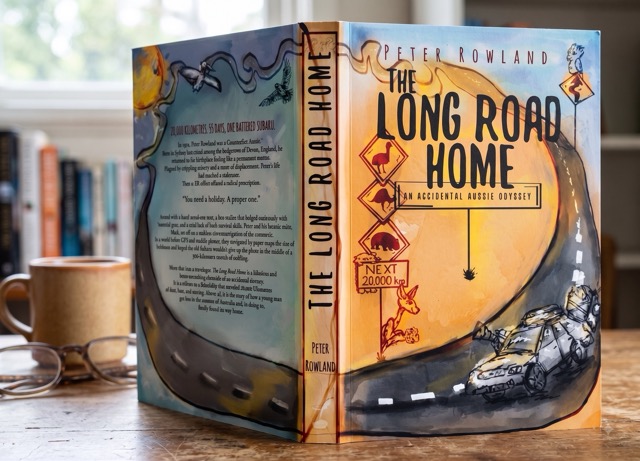
Experience the Full Story
You’ve seen the photographs and read the poetry – now experience the full 19,828-kilometre journey.
National Insect Expo: Woodend, VIC
Join me at the Woodend Buffalo Sports Stadium from October 2nd to 4th for the ABC 2026 Insect of the Year launch. Alongside the entomology exhibits, I will have signed physical copies of all of my book titles available. Come past and say hello!
Meet the Author: Book Fair Australia (Sydney) 2026
Looking for a signed copy? I will be exhibiting at Book Fair Australia on the 7th and 8th of November at the Sydney Showground (Sydney Olympic Park). Come past, say hello, and pick up a physical copy directly from the author.


About the Author
Peter Rowland is an acclaimed wildlife photographer, writer, and naturalist dedicated to exploring and documenting Australia’s unique ecosystems.
With a career rooted in a deep respect for the natural world, Peter is a seasoned author, collaborator, and lead editor whose work spans 17 publications on Australian ecology and wildlife. Over decades of fieldwork, he has paired this written expertise with an archive of over 100,000 nature images and video footage.
When he isn’t traversing remote outback tracks or wading through wetlands, Peter shares his honest storytelling and photography through his newsletter, blending the healing benefits of nature with mindful, Japanese philosophies like Wabi-sabi and Ichigo ichi-e.