Regent Honeyeater

This species features in my book Australia’s Birdwatching Megaspots


Scientific Name: Anthochaera phrygia
Size: up to 23 cm
What does it look and sound like?
Appearance and Key Features
The Regent Honeyeater is a large honeyeater, measuring around 23 cm in length
Juvenile Regent Honeyeater individuals look quite different from the adults
Similar Species
The Regent Honeyeater can be distinguished from the New Holland Honeyeater, which has white patches on its head and streaked, not scaled, underparts
Where is it found?
The Regent Honeyeater is found in south-eastern Australia, with a range that includes New South Wales, Queensland, and Victoria
What are its habitats & habits?
Habitats
The preferred habitats for the Regent Honeyeater are dry open forests and, particularly, box-ironbark woodlands
Habits and Diet
The Regent Honeyeater can be seen individually, in pairs, or in small groups
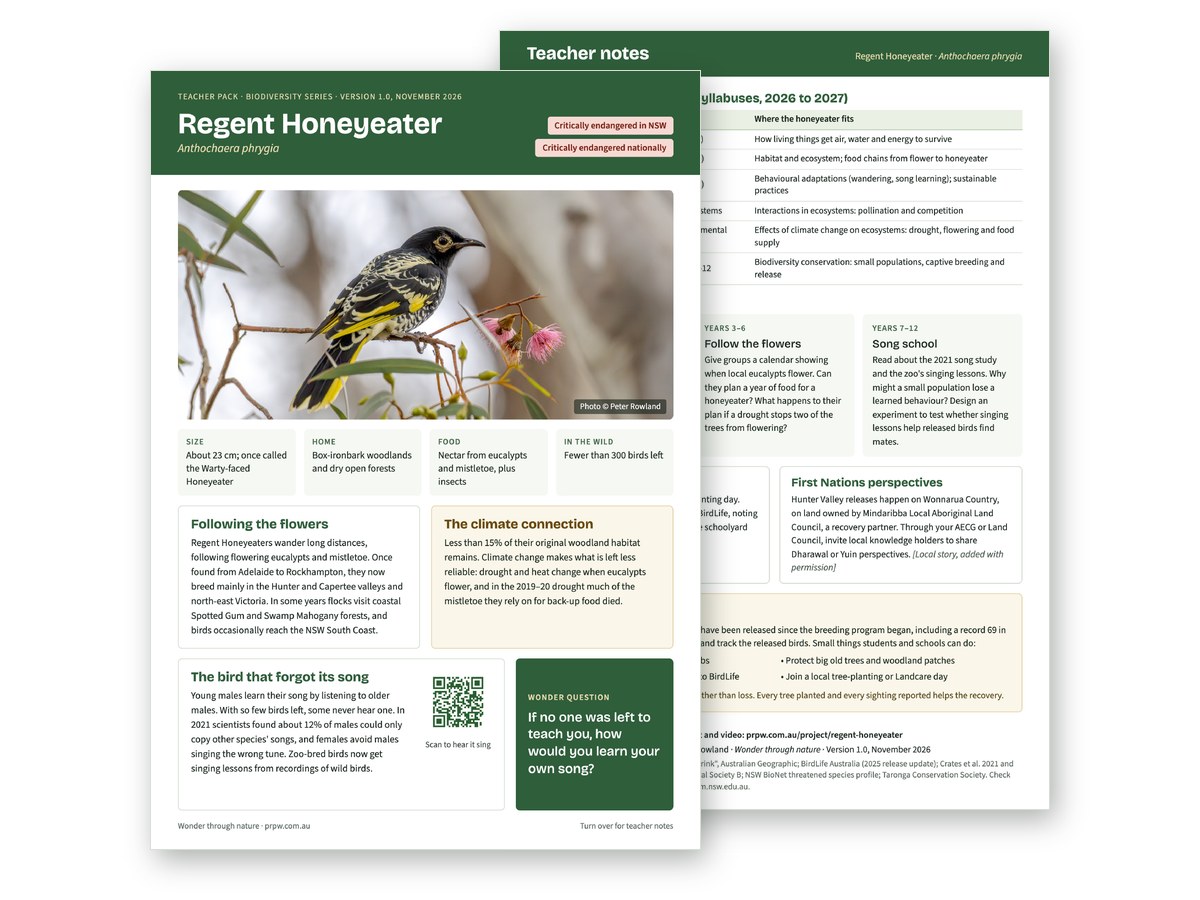
For teachers
A free two-sided A4 sheet for NSW classrooms, with curriculum links from Early Stage 1 to Stage 6, activities for K–2, Years 3–6 and Years 7–12, and ideas for getting outside. It is part of the PRPW Wonder through nature biodiversity series.